Showing posts with label wine. Show all posts

Sunday, 28 June 2026

Slow Cooker Bolognese

It's been a bit over a month since I made this, so I'm hoping that I can remember all the changes I made. The base recipe was fine, but the flavour was a bit flat, so I did end up tweaking it a bit just to punch things up a notch.

Slow Cooker Bolognese

Adapted from Pioneer Woman

Ingredients

  • 1 Tbsp. olive oil
  • 2 stalks celery, chopped
  • 1-2 carrots, grated
  • 1-2 onions, chopped
  • salt and pepper, to taste
  • 3-4 cloves garlic, minced
  • 1/4 c. tomato paste
  • 1/2 c. red wine
  • 1kg lean ground beef
  • 1 1/2 c. whole milk
  • 1 large (800mL) can crushed tomatoes
  • 1/2 Tbsp. dried oregano
  • 1/2 Tbsp. dried basil
  • 1 tsp. dried thyme
  • 1/4 tsp. red pepper flakes
  • 1 Parmesan rind (optional)
  • 2 Tbsp. brown sugar
  • 1 tsp. dark soy
  • 2 tsp. light soy
  • 1 tsp. Worcestershire sauce
  • 2 tsp. balsamic vinegar

Directions

  1. Heat olive oil over medium heat.
  2. Add celery, carrots, and onions and season to taste with salt and pepper. Cook until softened (~10 minutes).
  3. Add the garlic and tomato paste and cook until fragrant (3-4 minutes).
  4. Add the red wine and cook until mostly evaporated.1
  5. Meanwhile, in a separate pan, cook the ground beef and season with salt and pepper.
  6. Stir the milk into the beef and cook until mostly absorbed.
  7. Add the beef to the slow cooker along with the tomatoes, oregano, basil, thyme, pepper flakes, and parmesan rind (if using).
  8. Cover and cook on low for 6-12 hours.
  9. Taste and add sugar, soy sauces, Worcestershire sauce, and vinegar if needed.

1 If you have an InstantPot, then these steps can be done on the sauté setting. Otherwise, transfer veggie mixture to slow cooker once this step is complete. Back

Friday, 1 May 2026

Sauerbraten (German Sweet and Sour Beef)

When I was in NZ last year, I found an excellent deal on beef brisket and came home with a nice piece. It went in the freezer to be cooked later... But then I never quite got to it before I left. So it was still waiting for me in the freezer when I returned this year.

Another time I might've tried to smoke and/or barbecue it. But we're kind of out of grilling season in this hemisphere now and, after a year in the freezer, it was a bit freezer-burnt, so I decided to go for a slow cooker option instead.

After giving it a bit of thought and tossing around a few different ideas, I settled on taking a crack at turning it into sauerbraten. I have fond memories of the sauerbraten that my dad made. And, while I don't have his recipe, I figured I could at least ask the internet and try to come up with something similar. And it seemed like the ideal thing to do with a big chunk of slightly freezer-burnt beef.

The recipe that I used recommends using a bottom round or rump roast for this, but I figured the brisket would also work quite well. And it did! I really enjoyed how it came out. That said, I'm sure it would be good with other cuts too.


Sauerbraten

Slightly adapted from Daring Gourmet

Ingredients

  • 2 onions, chopped
  • 2-3 carrots, cut into large chunks
  • 1 leek, white parts only, thoroughly rinsed and chopped
  • 3-4 cloves garlic, minced
  • 1 tsp. dried thyme
  • 1 tsp. dried rosemary
  • 2 bay leaves
  • 8 juniper berries
  • 6 whole cloves
  • 10-12 black peppercorns
  • 2 1/2 tsp. coarse sea salt
  • 1 tsp. sugar
  • 2 1/2 c. red wine
  • 1 c. red wine vinegar1
  • 1 1/2 c. water
  • 1.5-2kg beef roast (brisket, bottom round, rump, etc.)
  • 1-2 Tbsp. oil or lard
  • 4 slices bacon, chopped (optional)
  • 1/4 c. flour
  • 1/4 c. raisins
  • 75-85g gingersnaps/gingernuts (6-7 gingernuts), crushed
  • 1 Tbsp. honey

Directions

  1. Combine the onion, carrot, leek, garlic, thyme, rosemary, bay leaves, juniper berries, cloves, peppercorns, salt, sugar, wine, vinegar, and water and bring to a boil.
  2. Reduce heat and simmer for 10 minutes.
  3. Remove from heat and allow to cool completely.
  4. Nestle the roast into the marinade, cover, and refrigerate for 4-7 days, turning each day if the marinade does not completely cover the meat.
  5. When ready to cook, remove the meat from the marinade and set aside.
  6. Strain the marinade and reserve both the solids and the liquids.
  7. Heat the oil over medium-high heat.
  8. Add the beef and sear on all sides. Set aside.
  9. Add the bacon (if using) to the now-empty pot and cook.
  10. Add the vegetables and sauté for ~5 minutes.
  11. Add the flour and cook until no longer raw (3-4 minutes).
  12. Pour in the reserved marinade, raisins, gingersnaps/gingernuts, and honey and bring to a boil.
  13. Add beef, cover, reduce heat to low, and simmer for 2-4 hours if cooking on the stovetop. Otherwise, transfer everything to a slow cooker and cook on "high" for ~6 hours. (Or use an InstantPot-style multi-cooker to do the whole thing in place.)
  14. Once beef is cooked through and tender, remove from the pot and set aside.
  15. If desired, remove the bay leaves, juniper berries, and cloves from the liquid and purée the veggies into it to make a thick gravy. Otherwise, adjust consistency by mixing in a cornstarch or flour slurry and boiling until gravy thickens to desired consistency.
  16. Adjust seasoning to taste.
  17. Slice beef and serve with the gravy (and veggies if you chose not to purée them).
  18. Serve with a starch (potatoes, bread, etc.) and rotkohl (sweet-and-sour red cabbage) or another vegetable dish of your choice.


1 I couldn't find any red wine vinegar, so I just used white wine vinegar. Either is fine. I think that cider vinegar would also be good in a pinch. Back

Friday, 3 October 2025

Maple Pumpkin Soup

This soup is a bit different than my usual approach to pumpkin soup. Quite often my soups will involve generous quantities of curry powder and coconut milk and quite often a bit of tomato as well. This one leans into maple syrup with a little bit of cayenne as the main seasoning. (Although I used Kashmiri chilies in my rendition of it.) I think I still prefer my usual curried version overall, but this was an interesting twist on the pumpkin soup theme. Especially with the sour cream and seasoned pumpkin seeds.


Maple Pumpkin Soup

Slightly adapted from Vegetable of the Day by Kate McMillan

Ingredients

  • 1/2 tsp. sugar
  • 1/2 tsp. sweet paprika1
  • 1/2 tsp. ground cayenne (or Kashmiri chilies), divided
  • 1/4 tsp. coarse sea salt, ground
  • 2 1/2 Tbsp. butter, divided
  • 7 Tbsp. maple syrup, divided
  • 1 tsp. water
  • 1/2 c. pumpkin seeds, toasted
  • 1 onion, finely chopped
  • 2-3 ribs celery, finely chopped
  • 2-4 cloves garlic, minced
  • 1/2 c. white wine
  • 4-5 c. chicken or vegetable stock
  • 1250g pumpkin purée2
  • 1/2 tsp. coarse sea salt
  • 1/4 tsp. black peppercorns, ground
  • 1 c. sour cream

Directions

  1. Combine the sugar, paprika, 1/4 tsp. of the cayenne, and ground sea salt and set aside.
  2. Combine 1/2 Tbsp. of the butter, 1 Tbsp. of the maple syrup, and the water and bring to a boil over medium heat.
  3. Add the pumpkin seeds and cook until liquid has evaporated and seeds are well-coated.
  4. Transfer to bowl with the paprika mixture and toss to coat.
  5. Spread out on a sheet of parchment paper to cool.
  6. Melt the remaining 2 Tbsp. of butter over medium heat.
  7. Add the onion and celery and cook until softened (~10 minutes).
  8. Add the garlic and cook for another minute or so.
  9. Add the wine, increase heat to medium-high, and cook until reduced by half.
  10. Add the stock and the pumpkin, reduce heat to medium-low, and simmer for ~10 minutes.
  11. If soup is chunkier than you'd like, use an immersion blender to smooth it out.
  12. Stir in the remaining 6 Tbsp. of maple syrup, sea salt, remaining 1/4 tsp. of cayenne, and pepper and simmer for an additional 10 minutes.
  13. Taste and adjust seasonings as desired.
  14. Serve topped with a dollop of sour cream and a sprinkle of the seasoned pumpkin seeds.


1 I just used plain sweet paprika this time, but I think that smoked sweet paprika would actually be really nice in this. Back
2 I used a mix of fresh and canned pumpkin for this. One 796mL can + 1 pie pumpkin yieled about the right amount. I cut the pumpkin in half, scooped out the seeds, rubbed it with a little olive oil, and baked it at 180°C (350°F) for 50 minutes, then scooped the flesh out of the skin. Back

Monday, 8 September 2025

Clambake

Lobster tails went on sale last week. $5 each! So, of course, I picked up a few. Then it was just a matter of figuring out what to do with them. I was already leaning toward making this clambake. And then I ended up with an accidental surplus of potatoes and corn. And I already had some extra fennel left over that needed to be used up. So this recipe was pretty much perfect to use up those ingredients.

To do it properly, I really should've gotten live mussels and clams and some jumbo shrimp to throw in the pot. But I was trying to do this as a relatively affordable meal, so instead of getting live shellfish, I got some frozen, pre-cooked, in-shell clams, plus a bag of frozen mixed seafood that included squid, mussel meat, and a few teeny, tiny shrimp. Obviously, this wasn't as nice as doing it properly, but it was still very good. Especially the lobster!


Clambake

Slightly adapted from Dish of the Day by Kate McMillan

Ingredients

  • 2 Tbsp. butter
  • 1 onion, chopped
  • 1 small bulb fennel, chopped and fronds reserved
  • 3-4 cloves garlic, minced
  • 2-3 sprigs fresh thyme (or 1/2 tsp. dried thyme)
  • 1/2 tsp. Old Bay (optional)
  • 1/8 tsp. black peppercorns, ground
  • 1 1/2 c. white wine
  • 3 c. chicken stock
  • 450g small potatoes, quartered
  • 450g kielbasa, sliced
  • 1-2 lobsters (or 4 small lobster tails)
  • 2 ears of corn, husked and quartered
  • 24 mussels, scrubbed and de-bearded
  • 24 clams, scrubbed
  • 12 large shrimp (preferably in-shell)
  • lemon wedges (optional)

Directions

  1. Melt the butter over medium heat.
  2. Add the onion, fennel, and garlic and cook until softened (5-8 minutes).
  3. Add the thyme, Old Bay (if using), and pepper and cook for another minute or two.
  4. Add the wine and cook until reduced by half.
  5. Add the chicken stock.
  6. Add the potatoes, then layer the kielbasa on top.
  7. Place the lobsters/lobster tails on top of everything, cover, and cook for 10 minutes.
  8. Add the corn, mussels, clams, and shrimp.
  9. Cover and cook for another 10-15 minutes.
  10. Scoop out the solids and place in a serving dish.
  11. Taste the broth and adjust seasonings as desired.
  12. Pour broth into the serving dish with everything else.
  13. Garnish with fennel fronds and serve with lemon wedges.

Tuesday, 2 September 2025

Capons Stwed

This was a really unusual recipe. The chicken (or capon, if you can find one) is essentially steamed over a bed of herbs and wine. So the skin doesn't crisp as all due to the moist environment, but it does come out incredibly tender.

Capons Stwed
Take parcelly, sauge, isoppe, rosemary, and tyme, and breke hit bitwen thi hondes, and stoppe the capon therewith; colour hym with safferon, and couche him in a erthen potte, or of brasse, and ley splentes underneth and al abouʒt the sides, that the capon touche no thinge of the potte. Strawe good herbes in þe potte, and put thereto a pottle of the best wyn that thou may gete, and none other licour; hele the potte with a close led and stoppe hit abouʒte with dogh or bater, that no eier come oute, and set hit on þe faire charcole, and lete it seeth easly and longe till hit be ynowe1. And if hit be an erthen potte, þen set hit on þe fire whan þou takest hit downe, and lete hit not touche þe grounde for breking. And whan þ3 hete is over past, take out the capon with a prik; then make a sirippe of wyne, reysons of corance, sugar and safferon, and boile hit a litull; medel pouder of ginger with a litul of the same syn and do þereto; then do awey the fatte of the sewe of the capon, and do the siryppe to þe sewe, and powre hit on þe capon, and serve it forth.

Capons Stwed

Slightly adapted from Pleyn Delit: Medieval Cookery for Modern Cooks by Constance B. Hieatt, Brenda Hosington, and Sharon Butler

Ingredients

  • 1 capon or roasting chicken
  • 1 handful flat-leaf parsley
  • 3-4 sprigs fresh sage
  • 3-4 sprigs fresh thyme
  • 3-4 sprigs fresh rosemary
  • 3-4 sprigs fresh hyssop
  • coarse sea salt2
  • 1/2-3/4 tsp. saffron threads, divided
  • 2 c. wine (red or white), divided
  • 1/4 c. dried currants
  • 1 tsp. sugar
  • 1/2 tsp. ground ginger

Directions

  1. Preheat oven to 230°C (450°F).
  2. Crush the herbs in your hand.
  3. Stuff half of the herbs into the chicken and place the rest in the bottom of a tagine or clay pot.
  4. Crumble 1/4-1/2 tsp. of the saffron and rub it and the salt into the skin of the chicken.
  5. Pour 1 c. of the wine into the bottom of the cooking vessel with the herbs.
  6. Place a rack in the pot/tagine and place the chicken on top.
  7. Cover very tightly.
  8. Place covered pot/tagine in oven and reduce oven temperature to 180°C (350°F).
  9. Bake at 180°C (350°F) until done. (20 minutes per pound + 20 minutes usually works well.)
  10. Remove chicken from oven.
  11. Strain the liquid from the bottom of the pot, chill, and skim the fat.
  12. Meanwhile, combine 3/4 c. of the remaining wine, currants, and sugar and bring to a boil.
  13. Simmer for 10-15 minutes.
  14. Stir in the remaining wine, saffron, ginger, and strained juices and cook for another 5 minutes.
  15. Serve the chicken with the sauce and sides of your choice.


1 I'm generally pretty good at figuring out the various middle and early modern English spellings, but I could not, for the life of me figure out what "ynowe" was supposed to be. Apparently it's an inflection of "ynogh", which is much more easily recognizable as an archaic version of "enough". I just didn't realize that it declined like that! Back
2 Neither the original recipe nor the modern interpretation of it called for any salt, but I really felt that it probably wanted some salt. My chicken was ~1.5kg, so I used 1/2 Tbsp. of salt. (I usually find that 1 tsp. of salt per kilo of meat is about right.) Back

Thursday, 10 April 2025

Smoked Trout Chowder

We had some lovely home-smoked trout left over from Reiver's birthday and he suggested that it might go well in a soup.

I've made fish chowder plenty of times before, but never with smoked fish. So I went looking for something that was tailored to smoked fish specifically. I found this one on the Food & Wine website. I will admit that I tweaked it slightly, but only slightly. I omitted the water called for. Used a regular commercial chicken broth (rather than low-sodium), but then omitted the salt. Halved the thyme. And, after tasting it at the end of cooking, decided to add in some corn and grated carrot as it seemed like it needed some more veg to balance it out and I usually put those in my chowders anyway.

Photo goes here.

Smoked Trout Chowder

Slightly adapted from Food & Wine

Ingredients

  • 1-2 Tbsp. butter
  • 2 ribs celery, chopped
  • 3-6 green onions, greens and whites kept separate and chopped
  • 2-3 cloves garlic, minced
  • 450g potatoes, cut into 1cm dice
  • 1/4 c. dry white wine
  • 4 c. chicken stock
  • 1/2 tsp. dried thyme
  • 1 bay leaf
  • 1/2 tsp. black peppercorns, ground
  • 1 c. frozen corn kernels
  • 1-2 carrots, peeled and grated
  • 1 c. half-and-half (10% MF)
  • 2 fillets smoked trout, skin removed and flesh flaked

Directions

  1. Melt the butter over medium-low heat.
  2. Add the celery, white parts of the green onions, and garlic and cook until softened (5-10 minutes).
  3. Add the potatoes, wine, chicken stock, thyme, bay leaf, and pepper.
  4. Increase heat to medium-high, bring to a boil, then reduce to medium and cook until potatoes are just tender (~15 minutes).
  5. Stir in the corn and carrots.
  6. Reduce heat to medium-low and stir in the cream.
  7. Cook for a few minutes, then stir in the trout.
  8. Serve with crusty bread.

Friday, 4 April 2025

Pullum Parthicum (Parthian Chicken)

I quite enjoy a bit of historical cooking. Cooking in the Archives has been a lot of fun (even if I don't always agree with their interpretations). And I've quite liked some of the recipes from Shakespeare's Kitchen and Townsends as well.

Reiver was actually the one who originally put me onto Townsends. And now he's shared a few more of his favourite cooking channels. One of which is Max Miller's Tasting History. I'm not necessarily a huge fan of the videos I've watched on his channel, but Reiver has his cookbook and had pointed out that we had all the bits for this chicken recipe. And, unlike some of his other recipes, he actually seems to have a reasonable source for this one and hasn't been overly... "creative" in his interpretation of it.

This was quite a surprising recipe. It honestly didn't really grab me at first. It looked unusual, but not that exciting. But, I have to say, this turned out very nice in the end! I don't think it was quite a favourite for me, but it was nice.

I never would have thought of combining red wine and fish sauce, but the combination works surprisingly well! And the caraway, black pepper, celery, and asafetida is a somewhat bewildering -- but not unpleasant -- way to complete the flavours.

I think I might put somewhat less wine next time. I do feel like using a full cup was a bit heavy-handed and possibly excessive for a recipe that calls for "seasoning" with wine. But otherwise, I really can't complain or suggest any changes or alterations. This was actually quite lovely!

We served our Parthian chicken over a bit of saffron rice with a slice of buttered rye bread and some silverbeet gratin on the side. This turns out to have been an excellent (and fairly thematically appropriate) combination. Would definitely recommend!

Parthian Chicken: Open the chicken and quarter. Pound pepper, lovage, a little caraway, moisten with garum, season with wine. Arrange the chicken in an earthen dish and put the seasoning on top. Dissolve silpuium in warm water, and put it with the chicken and cook. Sprinkle with pepper and serve.
-- Apicus, De re coquinaria


Pullum Parthicum

Slightly adapted from Tasting History by Max Miller

Ingredients

  • 1 whole chicken (~1.5kg)1
  • 3 Tbsp. fish sauce
  • 2 Tbsp. fresh lovage or 1/4 c. celery leaves2
  • 1/2 Tbsp. black peppercorns, ground
  • 1/2 Tbsp. caraway seeds, ground
  • 1/2-3/4 c. dry red wine
  • 3/4 tsp. ground asafetida
  • 1/4 c. warm water

Directions

  1. Preheat oven to 230°C (450°F).
  2. Quarter the chicken and place the pieces, skin-side-up, in a baking dish.
  3. Combine the fish sauce, lovage (or celery), pepper, and caraway and mix well.
  4. Stir in the wine.
  5. Pour this mixture over the chicken. Try to distribute the spices as evenly as possible and press them into the chicken skin a little.
  6. Stir the asafetia into the water and pour it over the chicken as well.
  7. Roast at 230°C (450°F) until chicken is cooked through and meat registers ~74°C/165°F (~45 minutes).
  8. Remove from oven and allow to rest for 10-15 minutes.
  9. Serve drizzled with the sauce and extra black pepper.


1 Honestly, any skin-on, bone-in chicken pieces should work reasonably well for this. I actually ended up using a bunch of thighs for my rendition. Back
2 I used both the leaves and the ribs of the celery for my rendition and liked that quite a lot. I only used one rib this time around, but Reiver and I agreed that a bit more would have been even better. Personally, I would recommend 1/4 c. of leaves + 2 ribs of celery if going that route. Back

Saturday, 22 February 2025

Citrus-Braised Lamb Shanks

This was meant to be done with lamb shanks, but I found some bone-in "lamb pieces" and shoulder chops on sale, so I opted to use those instead. The shanks would have been lovely (and probably resulted in everyone getting a bit more meat), but these were tasty too. And a lot cheaper!


Citrus-Braised Lamb Shanks

From Dish of the Day by Kate McMillan (p. 123)

Ingredients

  • 2 Tbsp olive oil
  • 4 lamb shanks, about 1 lb (450 g) each
  • 2 tsp. coarse sea salt
  • 1 tsp. black peppercorns, ground
  • 1 carrot, finely chopped
  • 1 yellow onion, finely chopped
  • 2 celery ribs, finely chopped
  • 3 small sprigs fresh thyme
  • 1 bay leaf
  • 3-4 cloves garlic, minced
  • 2 Tbsp tomato paste
  • 2 c. dry white wine
  • 1 c. chicken broth
  • Grated zest and juice of 1 lemon
  • Grated zest and juice of 1 lime
  • Grated zest and juice of 1 orange

Directions

  1. Heat 1 Tbsp of the oil over medium-high heat (preferably in a Dutch oven).
  2. Season the shanks with salt and pepper.
  3. Working in batches, sear the shanks, turning as needed, until browned on all sides, 6–8 minutes. Set aside.
  4. Preheat the oven to 120°C (250°F).
  5. Add the remaining 1 Tbsp oil to the pot and place over medium-low heat.
  6. Add the carrot, onion, and celery and sauté until softened (~5 minutes).
  7. Add the thyme, bay leaf, garlic, and tomato paste and cook for 1 minute.
  8. Add the wine, broth, and lemon and lime zests and juices.
  9. Return the shanks to the pot and bring the liquid to a gentle simmer.
  10. Cover and cook in the oven, turning the shanks every hour, until the meat is completely tender (2-3 hours).
  11. Transfer the shanks to a platter and keep warm in the oven.
  12. Pour the juices from the pot into a large, heatproof measuring pitcher and let stand for 1 minute. The fat will rise to the top. Use a bulb baster to transfer the juices underneath the fat to a small saucepan.
  13. Simmer to reduce slightly. Stir in the orange zest and juice.
  14. Drizzle the reduced juices over the lamb shanks and serve.

Monday, 10 February 2025

Barley Risotto with Chicken and Mushrooms

Mushrooms are on sale again, we had half a rotisserie chicken in the fridge, and there was silverbeet (Swiss chard) ready to harvest in the garden, so this recipe was a natural choice for dinner. Sadly, it didn't work out quite right. For whatever reason, the barley refused to cook. I gave it an extra half an hour of simmering and it was still somewhat al dente and more soupy than creamy. It was delicious anyway, but I was somewhat disappointed with the delays and final appearance, even if the flavour was still excellent.


Barley Risotto with Chicken and Mushrooms

Slightly adapted from Dish of the Day by Kate McMillan

Ingredients

  • 6 c. chicken stock
  • 1 Tbsp. olive oil
  • 1 onion, chopped
  • 2 cloves garlic, minced
  • 200g mushrooms, sliced
  • freshly ground pepper, to taste
  • 1/2 c. dry white wine
  • 1 c. pearl barley
  • 150g Swiss chard (silverbeet), chopped
  • 350g cooked chicken, shredded
  • 1/2 c. grated Parmesan

Directions

  1. Bring the stock to a boil, cover, and set aside.
  2. Heat oil over medium heat.
  3. Add onion and garlic and cook until softened (~5 minutes).
  4. Add mushrooms, cover, and cook until they have released their liquid.
  5. Season to taste with pepper, add the wine, and cook for another minute or two.
  6. Add the barley and 5 c. of the stock and bring to a boil.
  7. Reduce heat to medium-low and simmer, stirring occasionally, until most of the liquid has been absorbed.
  8. Add 1/4 c. of the remaining stock and cook, stirring often, until it has been absorbed.
  9. Repeat process with remaining stock.
  10. Add the chard along with the last portion of stock.
  11. Stir in the chicken and Parmesan and cook until heated through (3-5 minutes).
  12. Serve topped with additional Parmesan.

Tuesday, 4 February 2025

Roasted Whole Salmon with Potatoes and Spring Vegetables

They had whole, gutted and gilled salmon available at the grocery store here yesterday. They looked beautiful and fresh. And, notably, were about half the price per unit mass as the salmon fillets. So, given that, I figured I might as well just get a whole salmon and figure out how to cook it for dinner.

I did a mash-up of two different recipes for it. For cooking instructions, I followed a Jamie Oliver recipe that I found online. But I used the seasoning and side veggies from one of the Dish of the Day recipes. That one called for braising salmon fillets in a mixture of white wine and vegetable stock and then serving it with sautéed asparagus, leeks, and peas. For mine, I baked the salmon (and potatoes) as per Jamie Oliver, but stuffed it with leeks and lemon and then more-or-less braised the veggies to serve with it. It worked out quite well and we were all very happy with the results and looking forward to the leftovers tonight!


Roasted Whole Salmon with Potatoes and Spring Vegetables

Adapted from Jamie Oliver and Dish of the Day by Kate McMillan

Ingredients

  • 1 whole gutted and gilled salmon (~2kg)
  • 1-2kg potatoes, sliced ~5mm thick
  • 1 onion, halved and sliced
  • 2 leeks, divided
  • 1 lemon
  • 2 Tbsp. chopped fresh chives (or 1 Tbsp. dried), divided
  • 1 Tbsp. chopped fresh tarragon (or 1/2 Tbsp. dried), divided
  • 2-3 Tbsp. oil, divided
  • salt and pepper, to taste
  • 2 Tbsp. butter
  • 500g asparagus, trimmed
  • 1/4 c. white wine
  • 1/4 c. vegetable stock
  • 2 c. fresh or frozen green peas

Directions

  1. If the salmon still has its scales, you will want to descale it. This is a messy process. Put down some towels or paper and be prepared for scales to go flying everywhere. Drag the back of a knife from tail to head at a 45° angle. Repeat all over the fish until you've removed as many scales as possible. Rinse the fish and your knife and do another pass or two until it feels like all of the scales have been removed.
  2. Rinse the fish again, then dry thoroughly with a towel. Set aside.
  3. Preheat oven to 250°C (475°F) and oil a large roasting pan.
  4. Add the potatoes and onion to the pan, drizzle with 1 Tbsp. of the oil, and season to taste with salt and pepper.
  5. Rub the fish all over with the remaining oil and place it on top of the potatoes.
  6. Trim the leeks, halve lengthwise, wash very well, and slice.
  7. Zest the lemon.
  8. Combine the lemon zest with half of the leeks, 4-5 tsp. of the chives, 2 tsp. of the tarragon, and a bit of salt and pepper and toss to combine.
  9. Stuff as much of the leek mixture as possible into the salmon. Allow any excess stuffing to spill out onto the potatoes.
  10. Slice the lemon and stuff some of the slices into the fish.
  11. Make a few gashes in the skin of the fish.
  12. Sprinkle some salt and pepper over it, making sure to get some into the gashes.
  13. Place any remaining slices of lemon on top of the salmon (preferably over the gashes if possible).
  14. Bake at 250°C (475°F) for 15 minutes.
  15. Reduce temperature to 180°C (350°F) and bake for another 30 minutes.
  16. Meanwhile, melt the butter over medium heat.
  17. Add the remaining leeks and sauté until softened (3-5 minutes).
  18. Add the asparagus and cook for another minute or so.
  19. Add the wine, stock, remaining tarragon, remaining chives, and salt and pepper to taste; cover; and cook for 2-3 minutes.
  20. Add the peas and cook until vegetables are heated through and just tender (another 2-3 minutes).
  21. Serve the salmon and potatoes with the vegetables on the side.

Friday, 22 November 2024

Pears Poached in Red Wine

We had pears poached in white wine last week. And from there I moved onto poached plums, which were meant to get a red wine bath. (Although my poaching liquid was a bit of a franken-mix of red and white, but... close enough!) Well, after that, I still had a bunch of poaching liquid left over. And I hated to throw it out. So I picked out another wine-poached fruit recipe.

Honestly, I'd been hoping to do poached apricots next. They required a very similar poaching liquid, but with the addition of a small amount of rosewater. My intent had been to do the apricots and then, with the leftover liquid from that make these poached pears. But I couldn't find any fresh apricots (or nectarines) at the grocery store. So I skipped over that recipe for now and moved straight to the red wine pears.

As written, the recipe called for four Bosc pears poached in sweetened, spiced red wine. It used 3/4 c. of sugar to 750mL of wine + some cloves, cinnamon, and lemon zest. Since I already had a light syrup of a mix of red and white wine, cloves, cinnamon, lemon zest, star anise, peppercorns, vanilla, and ginger; I just reused it completely unaltered. And, since my pears were quite small, I tossed a few extras in. I managed to fit seven small pears into the pot with the poaching liquid.

Once I started boiling the syrup down, I gave it a taste and decided that it was slightly undersweetened for my liking. (I'm really not sure what the overall sugar-to-wine ratio was at this point. Since I'd already amended and reused it so many times.) So I stirred in 1 Tbsp. of extra sugar and let it continue cooking down. I feel like this produced a nice final result as a sauce to drizzle over the pears. That said, this is something that will be largely down to your personal taste (and the wine you use1).


Pears Poached in Red Wine

Slightly adapted from Dessert of the Day by Kim Laidlaw

Ingredients

  • 4-8 Bosc2 pears
  • 750mL fruity red wine
  • 3/4 c. sugar
  • 1 strip of lemon zest (~5cm long and 2.5cm wide)
  • 1 cinnamon stick (~7cm long)
  • 2 whole cloves
  • 2 Tbsp. unsalted butter

Directions

  1. Peel the pears, leaving the stem on.
  2. Using a small spoon or melon baller and starting from the blossom end, remove the cores. (Leaving the stem end in tact.)
  3. Trim a thin slice off the bottom of each pear so it will stand upright.
  4. Combine the wine, sugar, lemon zest, cinnamon stick, and cloves in a small pot and bring to a boil.
  5. Add the pears. If there is not enough liquid to cover them, add water until it does.
  6. Reduce heat to medium-low and simmer until pears are tender (20-30 minutes).
  7. Transfer pears to dish.
  8. Increase heat to medium and boil syrup down until it is somewhat thick and volume is reduced to ~3/4 c.
  9. Remove from heat and stir in butter.
  10. Drizzle sauce over pears and serve.


1 This recipe (and the one for the poached plums that I did before this) calls for a "fruity red wine" and suggests a Merlot or a Zinfandel as good options. I wasn't about to go out and get a whole new bottle of wine just for this, so I used whatever I had on hand already. And I have no idea whether it was a "fruity" wine or not. (Although hopefully all the rounds of fruit poaching in it did serve to lend it some fruitiness.) I think it was relatively dry, but I have no idea whether that has any bearing on its fruitiness or not. I am not a wine person. Back
2 The recipe specifically calls for Bosc pears, so that's what I used. That said, I do think it would be interesting to try it with other varieties. I ended up using Bartlett pears for the white wine version and I quite liked those. Don't get me wrong, the Bosc were nice. I'd just be interested to see how Bartlett or Anjou pears turned out when given this treatment. Back

Saturday, 16 November 2024

Poached Plums with Vanilla Mascarpone

Keeping the poached fruit train rolling! And this plum recipe was next up. TF and I didn't enjoy this one quite as much as the pears or the quince, but it was still good. And I'm enjoying getting to try all of these different poached fruit desserts.

This one calls for one bottle (750mL) of red wine that has been seasoned with cloves, star anise, and ginger and sweetened with 1 c. of sugar. But, since I was still using leftover syrup from the previous poached fruit recipes, I just chose to add the relevant spices and 1 c. of red wine to the syrup I already had.

For the actual recipe below, I've written it up as given in the book. But I'll try to briefly run through what I actually did here. Just so that I have a record of it.
  • Made a syrup of 2 c. water, 2 1/2 c. sugar, vanilla, and lemon zest; poached qince in it
  • To the residual syrup, added 1 1/2 c. white wine, peppercorns, cinnamon, star anise; poached more quince in it
  • To that residual syrup, added 1/2 c. white wine and fresh ginger; poached pears in it
  • Finally, to the resulting syrup, added 1 c. red wine, cloves, and additional star anise; poached plums in it


Poached Plums with Vanilla Mascarpone

Slightly adapted from Dessert of the Day by Kim Laidlaw

Ingredients

  • 750mL fruity red wine
  • 17 Tbsp. sugar, divided
  • 2-3 slices fresh ginger
  • 3 whole cloves
  • 3 whole star anise
  • 2 (7cm long) cinnamon sticks
  • 900g red or black plums, peeled and quartered
  • 1 c. mascarpone
  • 1 tsp. vanilla extract

Directions

  1. Combine the wine, 1 c. of the sugar, ginger, cloves, star anise, and cinnamon sticks and bring to a boil.
  2. Add plums, reduce heat slightly, and simmer until softened (8-10 minutes).
  3. Meanwhile, combine the mascarpone, vanilla, and remaining 1 Tbsp. sugar.
  4. Use a slotted spoon to transfer plums to bowls.
  5. Serve topped with mascarpone.

Friday, 8 November 2024

Poached Quince with Mascarpone, Caramel, and Gingersnaps

These were absolutely delicious! TF and I both had seconds. I really loved the combination of flavours and textures. (Even if I did undercook my caramel slightly.) This is definitely my new favourite thing to do with quince!

I did cheat slightly on the syrup for these quince. Recipe as written, it's meant to be made with an entire (750mL) bottle of Riesling, 1 c. of sugar, and a few spices. But I still had a bunch of syrup left over from making the quince poached in vanilla syrup the day before, so I just added the spices and a bit of white wine to that and called it a day. This does mean that my final syrup was a bit different than the recipe called for though:
  • The original recipe called for a 1:3 ratio of sugar to liquid (by volume); my starting syrup was 1.25:1 sugar to water (which I then diluted with wine to bring it closer to 1:1.5)
  • The original recipe used Riesling as the liquid; mine had a mix of water and white wine
  • The original contained star anise, cinnamon, and black peppercorns; mine had those, but also the residual vanilla and lemon zest from the previous recipe

I was quite happy with the overall result. And I was pleased that I was able to reuse the vanilla syrup from the first recipe. The catch is that this does make it somewhat difficult to write up accurately.

I've written up the recipe below based on how I'd do this next time if I didn't have the pre-existing vanilla syrup to build on. I haven't had a chance to test it yet, but I think it would give good results.


Poached Quince with Mascarpone, Caramel, and Gingersnaps

Slightly adapted from Dessert of the Day by Kate McMillan

Ingredients

Quince

  • 750mL Riesling
  • 1 c. sugar
  • 2 (7cm) cinnamon sticks
  • 1 star anise
  • 1/2 tsp. black peppercorns
  • 1 vanilla bean, split lengthwise
  • 1/2 Tbsp. grated lemon zest
  • 3-4 quince, peeled and halved1

Caramel

  • 1 c. sugar
  • 1/4 c. water
  • 2/3 c. heavy (35%) cream
  • 3 Tbsp. unsalted butter
  • 1/2 tsp. vanilla extract
  • 1/4 tsp. coarse sea salt

Assembly

  • 225g mascarpone
  • 6-8 Tbsp. crushed gingersnaps

Directions

  1. Combine the Riesling, sugar, cinnamon sticks, star anise, black peppercorns, and vanilla bean and bring to a boil over medium heat.
  2. Add the lemon zest and quince and reduce heat to medium-low.
  3. Simmer until quince are tender (~1 hour).
  4. Meanwhile, combine sugar and water for caramel, cover, and bring to a boil over medium-high heat.
  5. Uncover and continue cooking, swirling (but not stirring) often until sugar turns a rich caramel colour2.
  6. Remove from heat and carefully whisk in the cream. Stir until smooth.
  7. Stir in the butter, vanilla, and salt. Set aside.
  8. Once quince are tender, remove from heat and allow to cool in poaching liquid.
  9. Use a spoon or melon baller to scoop out the cores.
  10. Mix 3 Tbsp. of the poaching liquid into the mascarpone.
  11. Place a quince half in each bowl and top with a generous spoonful of mascarpone.
  12. Drizzle with caramel, sprinkle with crushed gingersnaps, and serve.


1 The original recipe calls for poaching the quince first and then coring them. I found this quite tricky to do. Next time I'd be tempted to try coring them before poaching. (With the obvious caveat that I have not had a chance to test this approach yet.) Back
2 I ended up burning the last batch of caramel I made, so I was a little paranoid this time and took mine off the heat a bit too soon. The flavour was fine, but the colour was very pale and unappealing. I think it needed another 30 seconds or so to properly darken. Back

Sunday, 3 November 2024

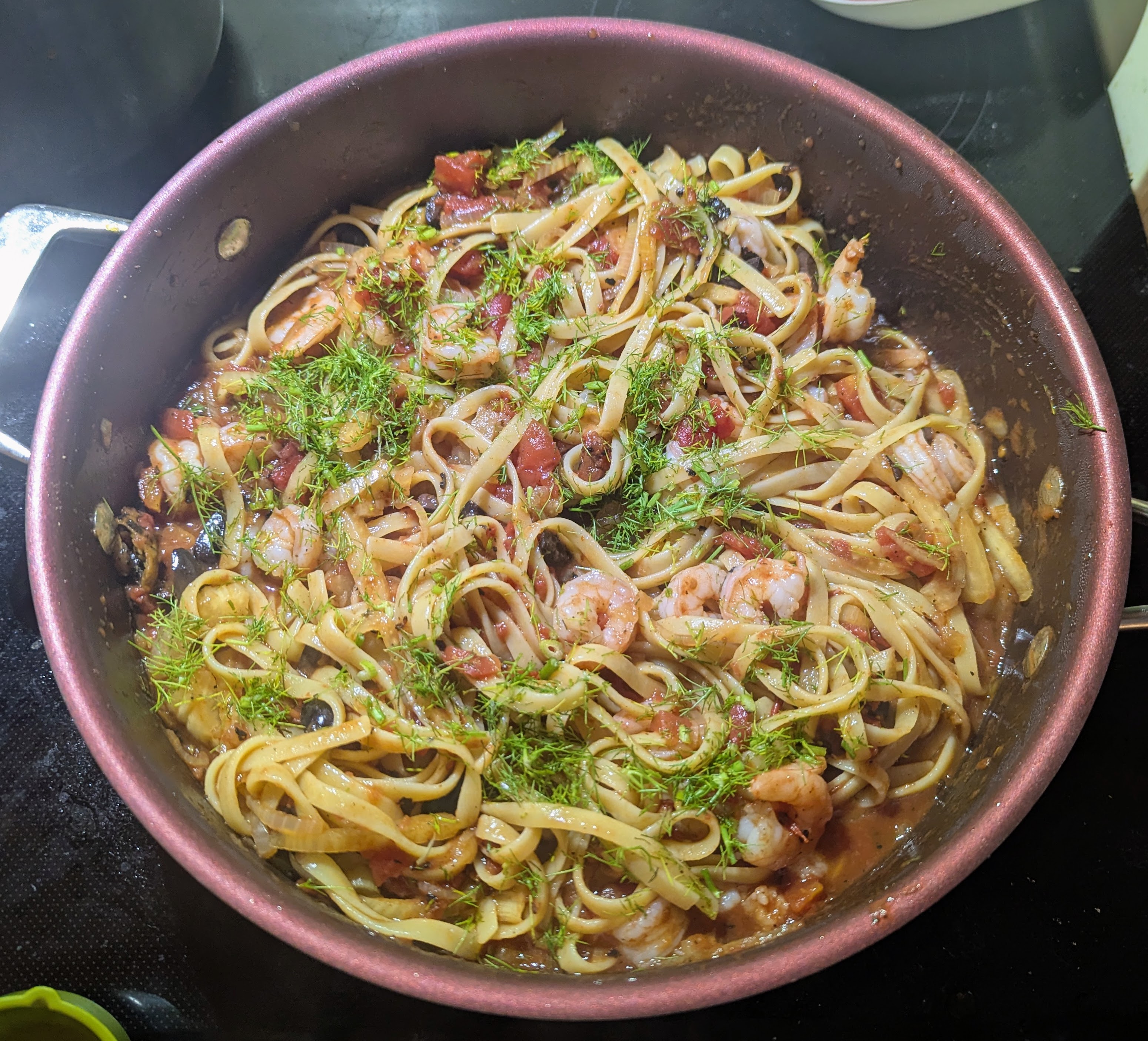
Spaghetti with Shrimp and Fennel

We've been on a bit of a shrimp and pasta kick lately. After six years of avoiding it due to suspected allergies, it's nice to finally be able to enjoy a bit of seafood again. And TF is a big fan of shrimp with pasta, so we've been leaning into that now that the shellfish ban has been lifted.


Spaghetti with Shrimp and Fennel

Slightly adapted from Dish of the Day by Kate McMillan

Ingredients

  • 1 Tbsp. olive oil
  • 1/2 tsp. fennel seeds
  • 1 fennel bulb, cored and thinly sliced, fronds chopped and reserved separately
  • 1 onion, halved and sliced
  • 1/4 tsp. red chile flakes
  • 1/4 tsp. coarse sea salt
  • 1/8 tsp. black peppercorns, ground
  • 1 large (~800mL) can whole or diced tomatoes (preferably San Marzano)
  • 1/4 c. kalamata olives (~15), pitted and quartered
  • 3 Tbsp. dry white wine
  • ~350g spaghetti (or other long pasta, preferably multi-grain or whole wheat)
  • 350g raw shrimp, peeled and deveined
  • Parmesan or pecorino Romano, to serve

Directions

  1. Heat olive oil over medium heat.
  2. Add fennel seeds and sizzle for 10-20 seconds.
  3. Add fennel bulb, onion, chile flakes, salt, and pepper and cook, stirring occasionally, for ~10 minutes.
  4. Add tomatoes, olives, and wine and cook until thickened slightly (5-8 minutes).
  5. Meanwhile, cook spaghetti according to package directions, reserving ~1 c. of the pasta cooking water before draining.
  6. Add shrimp to sauce and cook until shrimp are just done (~3 minutes).
  7. Add reserved pasta water to sauce and stir vigorously.
  8. Add drained spaghetti and toss to combine.
  9. Adjust seasoning to taste, top with reserved fennel fronds and Parmesan, and serve.

Saturday, 26 October 2024

Pasta with Rosemary Lamb Sugo

This is a very simple tomato sauce with lamb and zucchini. It incorporates no herbs or seasonings other than the rosemary and a bit of salt and pepper. (I did add a single clove of garlic as well, but that wasn't in the original recipe.) I also added a bit of tomato paste and some pasta water to give the sauce a little more body.

I think it probably could have done with a little more simmering, just to deepen the flavours a bit more, but it was still quite nice as it was. And doing it with the short simmer recommended by the recipe does, at least, make it a quick meal to prepare.


Pasta with Rosemary Lamb Sugo

Slightly adapted from Dish of the Day by Kate McMillan

Ingredients

  • 2 Tbsp. olive oil
  • 1 large onion, chopped
  • 1 clove garlic, minced
  • 2 Tbsp. fresh rosemary, minced
  • 450g ground lamb
  • 1/2 Tbsp. salt, divided
  • 1/2 tsp. black peppercorns, ground
  • 2 Tbsp. tomato paste
  • 1/4 c. dry white wine
  • 1 (~800mL) can diced tomatoes
  • 2-3 small zucchini, diced
  • 375g rotini (or other short) pasta, cooked
  • 1/4 c. grated pecorino Romano

Directions

  1. Heat oil over medium heat.
  2. Add onion, garlic, and rosemary, and cook until softened and beginning to brown (~10 minutes).
  3. Add lamb, 1 tsp. of the salt, and the pepper and cook until lamb is no longer pink (~5 minutes).
  4. Add tomato paste and cook until darkened (~3 minutes).
  5. Add wine and cook until almost completely evaporated (3-5 minutes).
  6. Add tomatoes, bring to a boil, reduce heat to medium-low, and simmer for 10-20 minutes, stir only very occasionally.
  7. Add the zucchini and cook for another 10-15 minutes.
  8. Meanwhile, cook pasta according to package directions.
  9. Once pasta is al dente, add ~1/4 c. of the pasta water to the sauce and stir it in vigorously.
  10. Drain the pasta (discarding the rest of the pasta water) and add the pasta to the sauce, mixing well.
  11. Stir in the cheese.
  12. Serve topped with additional Romano or Parmesan.

Sunday, 11 August 2024

Braised Chicken with Wax Beans and Tomatoes

Unfortunately, I have no recollection of making this recipe. I know I made it because I wrote it down, along with the title and page number of the book it appeared in, in my notes. And TF says she thinks it sounds familiar. But I don't remember it at all!

I suspect that I probably swapped out the fresh wax (yellow) beans for frozen green beans because I often have the later on hand and never the former. But I can't say for sure. It's possible that I went out and got some fresh yellow beans especially for this recipe. But I doubt it.

I may have even swapped out the cherry tomatoes for tinned diced tomatoes. But, again, I can't say for sure. But it's the kind of thing that I could see myself doing for a recipe like this. Especially if I was in a bind over what to have for dinner and trying to cobble something together last-minute.

One change that I'm almost certain I would have made is to the chicken. Recipe as written, it calls for chicken thighs and drumsticks. I suspect that I probably just got a whole chicken and broke it down (breasts, wings, durmsticks, thighs) and used that rather than going for the all dark meat approach. I've written up the recipe to reflect this change, but left everything else as it was in the original recipe since I can't remember exactly what I did. Possibly not the most accurate accont. But, since it wasn't a stand-out in my mind anyway, I doubt we'll be revisiting it, so the details become far less important at that point.

Braised Chicken with Wax Beans and Tomatoes

Slightly adapted from Dish of the Day by Kate McMillan

Ingredients

  • 1 Tbsp. olive oil1
  • 1 whole chicken (~1kg), broken down into pieces (legs, thighs, breasts, wings)
  • 1 tsp. coarse sea salt
  • 1/4 tsp. black peppercorns, ground
  • 1 onion, chopped
  • 1 carrot, chopped
  • 6-8 cloves garlic, minced
  • 1 1/4 c. dry white wine
  • 3 c. chicken stock
  • 3 sprigs fresh thyme2
  • 1/4 c. heavy (35%) cream
  • 3 Tbsp. Dijon mustard3
  • 1 c. cherry tomatoes
  • 125g yellow wax beans
  • 90g arugula (rocket/roquette)

Directions

  1. Preheat oven to 180°C (350°F).
  2. Warm oil over medium-high heat.
  3. Season chicken with salt and pepper.
  4. Sear chicken, turning as needed and working in batches if necessary, until golden-brown (8-10 minutes). Set aside.
  5. Add onion, carrot, and garlic to the pot, season to taste with additional salt and pepper, and sauté until softened (~5 minutes).
  6. Add wine, bring to a simmer, and cook until reduced by half (~5 minutes).
  7. Add chicken stock and bring to a boil.
  8. Return chicken to pot and add thyme.
  9. Cover, transfer to oven, and braise at 180°C (350°F) until chicken is cooked through (50-60 minutes).
  10. Transfer chicken to a plate.
  11. Strain the braising liquid and return to pot.
  12. Bring to a boil and cook until reduced by half (8-10 minutes).
  13. Reduce heat to medium, stir in cream and mustard, and cook until thickened slightly (~5 minutes).
  14. Adjust seasoning to taste.
  15. Return chicken to pot, cover, and cook for another 15 minutes.
  16. Add tomatoes and beans and cook, covered, until softened (~5 minutes).
  17. Uncover, stir in the arugula, and cook until wilted (1-2 minutes).


1 I know I said that I was going to leave everything but the chicken the same, but I realized that this was one other area where I also almost certainly made some adjustments. The original recipe calls for 2 Tbsp. of oil. But it also calls for skin-on chicken. And I always find that a lot of fat renders out of the skin. So I would be reluctant to add that much oil to the pan unless I was going to use skinless chicken pieces. Honestly, with skin-on chicken, I'm not sure you really need any added fat at all! But I decided to write it up with half the amount since, as noted, I can't remember exactly what I did for this. Back
2 I basically never have fresh thyme on hand and I doubt that I would have gone out and gotten any for this. I suspect that I substituted dried thyme. I would guess ~1 tsp. or so. But, as with the other details, I can't say for sure. (This is why it's important to write up your notes promptly! Oh well...) Back
3 I definitely would have used Roman mustard for this. I'm just not sure how much. Sometimes I cut back on the quantity called for somewhat because the Roman mustard is so strong. I probably would have started with ~2 Tbsp. and adjusted from there. Back

Monday, 15 April 2024

Modified Fettucini al Ragu

We've made this as-written at least twice, but it looks like neither time made it into the blog. This version, meanwhile, deviates somewhat from the recipe in Hazan; I wanted to increase the ratio of veggies to everything else somewhat, and I also needed to get it done fast because I was starting late and could not afford the usual 3-4 hour cooking time. To that end, I used a generous quantity of mirepoix mix for the veggies, added some spinach, and skipped the slow simmering and cooking down of the tomatoes in favour of using a smaller quantity of pre-diced tomatoes.

I would definitely make it this way again; symbol and I both liked it, and the Kidlet declared it to be "beyond favourite".


Modified Fettucini al Ragu

The Classic Pasta Cookbook by Guiliano Hazan (pp. 62-63)

Ingredients

  • 400-450g fettucini or other pasta
  • 2 tbsp olive oil
  • 2+2 tbsp butter
  • 360mL (1½ C) frozen mirepoix mix
  • 5-6 garlic cloves, chopped
  • 450g (1 lb) extra lean ground beef
  • ½ tsp salt, ground
  • ½ tsp pepper, ground
  • 120mL (½ C) frozen chopped spinach
  • 240mL (1 C) white wine
  • 120mL (½ C) milk
  • ⅛ tsp grated nutmeg
  • 1×375mL tin diced tomatoes
  • freshly grated parmesan

Directions

  1. Heat the oil and half of the butter in a large, deep-sided skillet over medium heat.
  2. Add the mirepoix mix and cook, stirring occasionally, until thawed and the onion has just started to brown.
  3. Add the garlic and cook until fragrant, 30-60 seconds.
  4. Add the ground beef, salt, and pepper, and cook, breaking up and stirring as needed, until cooked through and just browned.
  5. Stir in the spinach and cook until just thawed.
  6. Add the wine and cook until it has completed evaporated.
  7. Add the milk and nutmeg and cook, stirring frequently, until mostly evaporated.
  8. Add the tomatoes and cook until they are bubbling and the sauce has just begun to thicken.
  9. Reduce heat to low and set aside until the pasta is cooked al dente.
  10. Combine pasta, sauce, and remaining butter and toss until the butter is melted and the pasta is evenly coated; serve.

Thursday, 11 April 2024

Chicken Pot Pie

The Kidlet was having a friend over for dinner the other day and I wasn't sure what they liked, so I tried to play it safe with this chicken pot pie. I hoped it would be a fairly... unintimidating dish without any overly strong flavours or unusual ingredients. The Kidlet certainly liked it! I may need to work on dailing things in with the friend a bit, but it was a decent start.

In theory this is meant to make one 9" pie. In practice, I ended up with more filling than would fit in a 9" pie plate, so I ended up making an additional 4 small pies by pouring the excess filling into ramekins and topping them with a bit of the extra pastry.


Chicken Pot Pie

Slightly adapted from Dish of the Day by Kate McMillan

Ingredients

Pastry

  • 210g all-purpose flour
  • 6 Tbsp. shortening or lard
  • 2 Tbsp. unsalted butter
  • 1/3 c. cold water

Filling

  • 1 c. sliced carrots
  • 1 c. fresh or frozen peas
  • 1 c. fresh or frozen corn kernels
  • 2 Tbsp. unsalted butter
  • 500g skinless boneless chicken thighs, cut into bite-sized pieces
  • salt and pepper, to taste
  • 1 small red onion, chopped
  • 1 clove garlic, minced
  • 1/4 c. all-purpose flour
  • 1 1/2 c. chicken stock
  • 1/2 c. dry white wine
  • 1/2 c. half-and-half (10% MF)
  • 2 Tbsp. chopped flat-leaf parsley
  • 1 small egg
  • 2 tsp. water

Directions

  1. Cut the butter and shortening into the flour.
  2. Mix in the water, 1 Tbsp. at a time, until the dough comes together.
  3. Shape into a ball, wrap tightly, and chill for at least 30 minutes.
  4. Meanwhile, cook the carrots in salted water until tender-crisp (~3 minutes).
  5. If using fresh peas and corn, boil them for ~1 minute. If using frozen, just add them to the boiling water and then immediately remove from heat. Drainth eveggies and set aside.
  6. Preheat oven to 200°C (400°F).
  7. Melt the butter over medium heat.
  8. Add the chicken, season to taste with salt and pepper, and cook until browned on all sides (8-10 minutes).
  9. Add the onion and garlic and cook until softened (2-4 minutes).
  10. Add the flour and cook for another minute or two.
  11. Pour in the broth, wine, cream, and parsley and bring to a simmer.
  12. Reduce heat to medium-low and simmer for 10 minutes.
  13. Add the veggies and adjust seasoning to taste.
  14. Pour the filling into a 23cm (9") deep dish pie plate. (You may have some extra.)
  15. Roll out the dough on a lightly floured surface.
  16. Beat the egg with the water and brush a little egg wash around the edges of the pastry, then place the pastry, egg-side-down, over the pie.
  17. Press pastry to adhere and crimp edges.
  18. Brush the top of the pie wiht more egg wash and cut one or more small holes or slits in the crust.
  19. Place on a baking sheet and bake at 200°C (400°F) for ~30 minutes.

Saturday, 27 January 2024

Beef Bourguinon

TF and I grew up with very different concepts of "stew".

For me, stew was a boiled dinner consisting of large chunks of meat, potatoes, and other vegetables (usually cabbage, turnip/rutabaga/swede, and carrots) in a thin, clear broth. The potatoes would be cut in half -- or even left whole if they were on the small side -- and the other veggies would be in similarly large pieces. You were expected to need a knife and fork to eat your stew with a spoon to finish off the broth.

TF, on the other hand, grew up with stew being a thick, brown meaty mixture with any veggies present being cut small enough and cooked long enough that they broke down and merged into the rich gravy that swathed the fall-apart tender meat.

TF is very fond of her family's stew. (As am I, for that matter.) So when I saw this recipe for bourguinon, I knew it would be an instant hit. It's basically her favourite stew, but with pancetta, a bottle of red wine, mushrooms, and an entire bag of pearl onions tossed in. So, you know, the same but better!


Beef Bourguinon

Slightly adapted from Dish of the Day by Kate McMillan

Ingredients

  • 1.5kg stewing beef1
  • 1 tsp. coarse sea salt, divided
  • 1/2 tsp. black peppercorns, ground, divided
  • ~1/4 c. all-purpose flour
  • 1 Tbsp. olive oil
  • 180g pancetta, diced
  • 1-2 carrots, sliced
  • 1 onion, chopped
  • 750mL red wine
  • 2-3 cloves garlic, minced
  • 1/2 Tbsp. dried thyme
  • 1 bay leaf
  • 1 Tbsp. tomato paste
  • 2 Tbsp. unsalted butter, divided
  • 450g cremini mushrooms, sliced
  • 24 thawed frozen pearl onions (give or take)

Directions

  1. Sprinkle the 1/2 tsp. of the salt and 1/4 tsp. of the pepper over the meat.
  2. Toss the meat with the flour to coat. Use extra flour as needed.
  3. Heat the oil over medium-low heat.
  4. Add the pancetta and cook until crisp (~5 minutes).
  5. Use a slotted spoon to transfer the pancetta to a bowl and set aside.
  6. Raise heat to medium-high and, working in batches, sear beef on all sides. Transfer beef to bowl with pancetta.
  7. Add carrot and onion to pot and cook until browned (~5 minutes). Transfer to bowl with meat.
  8. Reduce heat to medium and add the wine.
  9. Stir and scrape to deglaze the pan, then return meat and veggies to the pot.
  10. Add the garlic, thyme, bay leaf, tomato paste, and remaining 1/2 tsp. salt and 1/4 tsp. pepper.
  11. Bring to a simmer, then reduce heat to low, cover, and cook for 2-3 hours.
  12. Meanwhile, in a separate pan, melt 1 1/2 Tbsp. of the butter over medium heat.
  13. Add the mushrooms and cook until softened and lightly browned (~5 minutes). Add a little water and cover the pan for a few minutes if they seem to need help cooking. Transfer to a bowl.
  14. Add the pearl onions and the remaining 1/2 Tbsp. of butter to the pan and cook until golden (~10 minutes). Remove from heat and set aside.
  15. Once the beef has cooked for 2-3 hours, add the mushrooms and onions to the pot.
  16. Stir to combine and cook for another hour.
  17. Once the stew is done, transfer all the solids to a serving dish.
  18. Skim as much fat as possible from the liquids, then raise the heat to medium-high and bring to a boil.
  19. Cook until the sauce thickens slightly (~2 minutes).
  20. If you would like a thicker sauce, you can separate out a few Tbsp., allow it to cool slightly, and then mix in a couple tsp. of extra flour. Mix this slurry back into the sauce and cook for a few more minutes or until desired thickness is achieved.
  21. Pour the sauce over the meat and serve. Ideally with a crusty loaf of fresh bread.


We were a bit short on stew meat, so I cut up some sirloin steak to make up the difference. Back

Friday, 15 December 2023

Mushrooms with Garlic Butter and Pine Nuts

We made a half batch of this on account of not having enough mushrooms, but it was delicious and I would be in favour of making it again with the normal amount (which I've written here) or even more, maybe with some of the nice mushrooms from the local mushroom farm.

Mushrooms with Garlic Butter and Pine Nuts

Dish of the Day by Kate McMillan

Ingredients

  • 500g assorted delicious mushrooms, stems trimmed
  • 4 tbsp butter, softened
  • 3 large cloves garlic, minced
  • 2 tbsp white wine
  • ⅓ C pine nuts
  • 2 tbsp chopped chives (fresh preferred, freeze-dried acceptable)
  • Directions

    1. Cut the larger mushrooms into quarters so that all the mushrooms are roughly the same size.
    2. Arrange mushrooms in a single layer on a baking sheet.
    3. In a bowl, mix together the butter and garlic. Season with salt and pepper to taste.
    4. Pour or dollop the butter mixture over the mushrooms.
    5. Bake at 450°F until they sizzle and brown, about 15 minutes.
    6. Turn, sprinkle with pine nuts, and bake for another 8-10 minutes, until pine nuts are browned.
    7. Remove from the oven, stir in chives, and serve.