Showing posts with label molasses. Show all posts

Wednesday, 17 September 2025

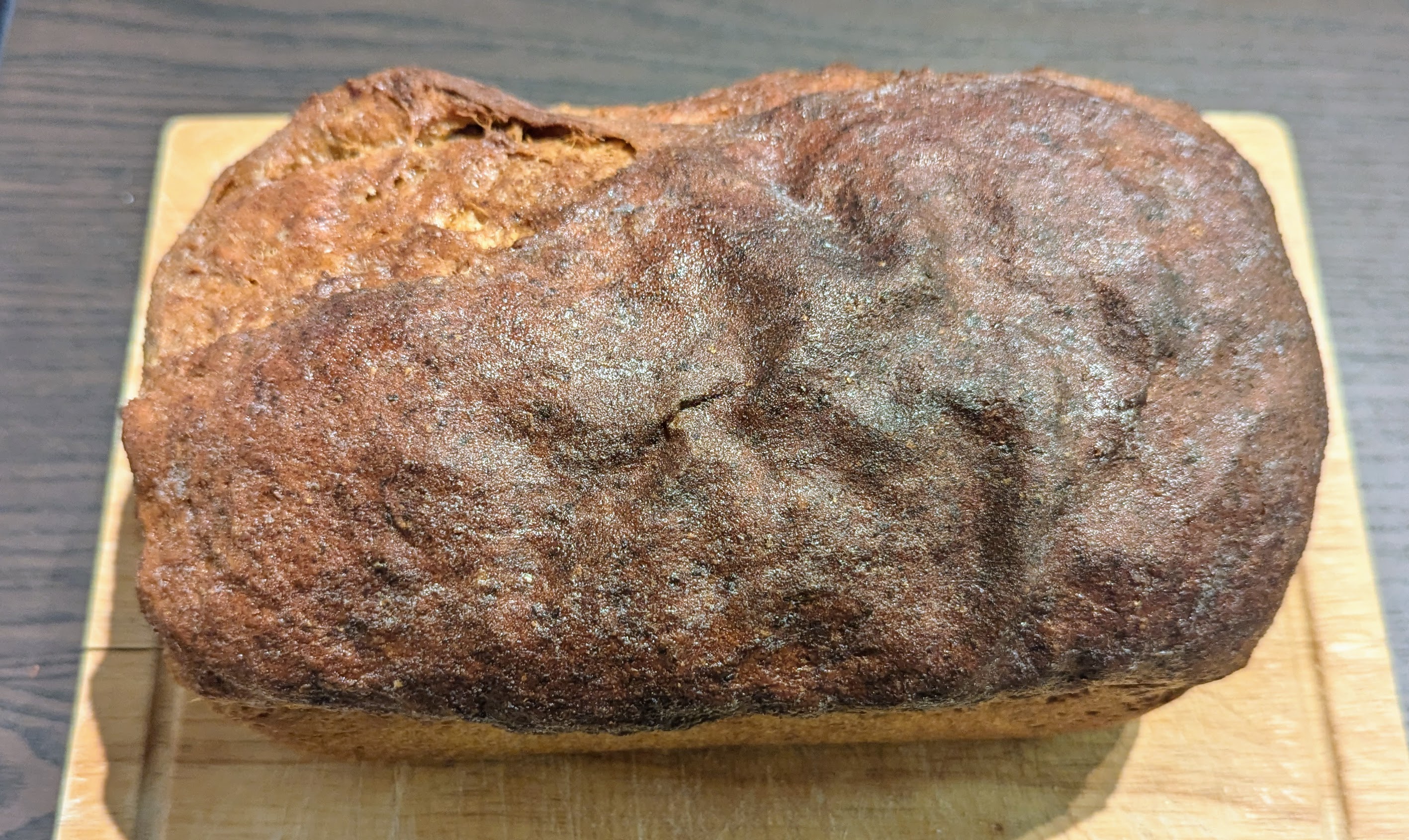
Pumpernickel Bread

It's coming up to Thanksgiving here and apparently everyone has been hit by the baking madness. That is to say: The grocery store was completely sold out of 2.5kg bags of white flour when I went to restock the other day. Not a huge problem, but it did mean that I needed to find a whole grain bread recipe to make this week. And, of course, preferably one that I hadn't made before. And this was the first one that I hit upon that I had all the ingredients for.

This recipe makes a lovely, dark, flavourful bread. It came out a bit sweet for my tastes, but still very good nonetheless. I might try reducing the molasses to 1/2 c. next time, just to see how that goes.

As expected, the dough was fairly sticky and challenging to work with due to the high percentage of rye flour, but it did come together eventually. Although it never got quite as supple and elastic as a predominantly wheat dough.


Pumpernickel Bread

Slightly adapted from Bernard Clayton's New Complete Book of Breads

Ingredients

  • 1 3/4 c. water
  • 1/2 c. cornmeal
  • 1/2-3/4 c. molasses
  • 1 Tbsp. butter
  • 1 Tbsp. coarse sea salt
  • 1/2 Tbsp. caraway seeds, bruised/lightly crushed
  • 15g dark chocolate
  • 250g sourdough discard @ 100% hydration (optional)
  • 2 1/4 tsp. active dry yeast
  • 1 c. mashed potatoes
  • 300g rye flour
  • 200-300g hard (strong/high grade/bread) whole wheat flour, divided
  • 1 egg white
  • 1 Tbsp. cold water

Directions

  1. Combine water and cornmeal and bring to a boil.
  2. Reduce heat and simmer until thickened (10-20 minutes).
  3. Remove from heat and stir in molasses, butter, salt, caraway seeds, and chocolate.
  4. Mix in the sourdough starter, yeast and mashed potatoes.
  5. Add the rye flour and ~150g of the whole wheat flour and mix well.
  6. Turn the dough out onto a well-floured surface and knead (the dough will be very heavy, wet, and sticky) for ~20 minutes. Gradually work in the remaining flour while kneading.
  7. Round the dough and place it in a covered bowl to rise.
  8. Once dough is well-risen (60-90 minutes), knock it back and divide into two equal portions.
  9. Round each portionn, cover, and allow to rest for ~10 minutes.
  10. Meanwhile, flour two bannetons (preferably with rice flour).
  11. Shape each portion into a loaf and place, seam-side-up into the floured bannetons.
  12. Cover and allow to rise at room temperature for 45-60 minutes.
  13. Preheat oven to 190°C (375°F).
  14. Grease a baking sheet and dust with cornmeal.
  15. Turn the loaves out onto the the prepared baking sheet.
  16. Beat the egg white with the cold water and brush it onto the loaves.
  17. Bake at 190°C (375°F) for 40-50 minutes.
  18. Turn off oven and allow to stand in hot oven for 5-10 minutes.
  19. Transfer to wire rack to cool.

Sunday, 7 September 2025

Molasses Wheat Bread

I haven't been great at keeping up with the bread baking lately. My poor starter is feeling a bit neglected and we've been largely bread-less over the summer.
I ended up rolling with this recipe today because it was the first one I found that a) I had all the ingredients for and b) didn't require an overnight sponge. And, honestly, it's delicious! I love it. I actually ate two slices immediately. Which I almost never do. And, while I did end up using the mix of white and whole wheat flour that the recipe called for this time, I think it would probably work really well as a 100% whole wheat loaf too!


Molasses Wheat Bread

Slightly adapted from Bernard Clayton's New Complete Book of Breads

Ingredients

  • 2 c. hot water1
  • 1/4 c. molasses
  • 1/2 c. dry milk powder
  • 1 Tbsp. coarse sea salt
  • 450g hard (strong/high grade/bread) whole wheat flour, divided
  • 350-450g hard (strong/high grade/bread) or all-purpose flour, divided
  • 250g sourdough discard @ 100% hydration (optional)
  • 3 Tbsp. butter
  • 4 1/2 tsp. active dry yeast (or ~1 Tbsp. instant yeast)

Directions

  1. Combine the hot water, molasses, milk powder, salt, and ~150g of each of the flours.
  2. Mix well and beat for a minute or two.
  3. Add the sourdough discard (if using) and the butter and beat for another minute.
  4. Add the remaining 300g of whole wheat flour and mix well.
  5. Beat for 2-3 minutes.
  6. Add the yeast and ~150g of the remaining white flour and mix by hand or with a dough hook.
  7. Work in as much of the remaining flour as needed to form a good dough. Flour may be worked in either by hook or by hand.
  8. Knead until dough is supple and elastic (~5 more minutes by hook or 15-20 minutes by hand, depending on the efficiency of your stroke).
  9. Round the dough and place it in a covered bowl to rise (~1 hour depending on room temperature).
  10. Knock the dough back and divide into two equal portions.
  11. Round each one, cover, and rest for 5-10 minutes.
  12. Meanwhile, grease two 20x10cm (8x4") loaf pans.
  13. Working with one portion of dough at a time, press flat and fold into thirds (letter fold). Then, instead of rolling up jelly-roll-style as usual, roll and stretch the dough into a log about 1.5x the length of the loaf pan. Now twist the log once or twice around and place it in one of the prepared loaf pans.
  14. Cover and set aside to rise for ~45 minutes at room temperature.
  15. Preheat oven to 190°C (375°F).
  16. Bake the loaves at 190°C (375°F) until done (30-45 minutes depending on how well-risen they were going in).
  17. If desired, remove from tin for last 5 minutes of baking to give the crust some extra crisp.
  18. Turn off the oven and allow the bread to stand in the hot oven for ~5 minutes.
  19. Turn out of pan and transfer to wire rack to cool.


1 I made my water very hot indeed and then just made sure to add everything else to it before adding the yeast. I was also adding cold sourdough discard out of the fridge which helped to bring the temperature down a bit. Back

Tuesday, 8 July 2025

Old Milwaukee Rye

I don't tend to make very many rye breads. I find the low-gluten flour difficult to work with and I still haven't mastered the technique. This one came out quite nicely though! It takes a while to get it going. The sour needs to ferment over three days. But it's worth the wait!

Old Milwaukee Rye

Slightly adapted from Berndard Clayton's New Complete Book of Breads

Ingredients

Sponge

  • 250g rye flour
  • 2 1/4 tsp. active dry yeast
  • 1 Tbsp. caraway seeds
  • 2 c. warm water (~40°C)

Dough

  • 1 c. hot water (~50°C)
  • 1/4 c. molasses
  • 2 Tbsp. caraway seeds, divided
  • 2 large eggs, divided
  • 1 Tbsp. coarse sea salt
  • 250g rye flour
  • ~500g hard (strong/high grade/bread) flour
  • 3 Tbsp. butter
  • 1 Tbsp. milk

Directions

  1. Combine the flour, yeast, caraway, and water for the sponge and beat for a minute or two.
  2. Cover the bowl tightly and set aside at room temperature to ferment for 6-72 hours, stirring once every 24 hours.
  3. Once ready to bake, add the hot water, molasses, 1 Tbsp. of the remaining caraway seeds, 1 of the eggs, and salt to the sponge.
  4. Stir in the remaining rye flour and ~250g of the white flour.
  5. Beat for 3-4 minutes, then mix in the butter.
  6. Work in the remaining white flour a little at a time.
  7. Turn the dough out onto a floured surface and knead for 10-20 minutes until smooth.
  8. Round the dough and place it in a covered bowl to rise (~1 hour).
  9. Knock the dough back, allow to rest for 5-10 minutes.
  10. Divide the dough into two equal portions and round each one.
  11. Cover and rest for another 10 minutes.
  12. Grease a baking sheet and dust it with cornmeal.
  13. Shape each loaf as desired. If you have bannetons, then a standard letter fold + coil fold works well. If not, then I like to do a letter fold and then round them again. Or do a letter fold and then fold in half lengthwise and pinch the seam together.
  14. If using bannetons, place the loaves seam-side-up in the bannetons. If no bannetons are available, place the shaped loaves directly on the prepared baing sheet (seam-side-down).
  15. Cover and allow to rise at room temperature for ~45 minutes or as long as overnight in the fridge.
  16. Preheat oven to 190°C (375°F).
  17. If the loaves have been rising in bannetons, turn them out onto the prepared baking sheet now.
  18. Beat the remaining egg with the milk.
  19. Brush the tops of the loaves with the egg mixture and sprinkle with the remaining caraway seeds.
  20. Slash as desired. (3-4 diagonal slashes for long loaves or a # pattern for round.)
  21. Bake at 190°C (375°F) for 35-45 minutes.
  22. Turn off oven and allow to stand in hot oven for 5-10 minutes.
  23. Transfer to wire rack to cool.

Wednesday, 18 June 2025

Gingerbread Waffles

I actually made these waffles several weeks ago, but I've still have a huge backlog of recipes to write up, so this one is very late in getting posted.

These were pretty good. Not may favourite waffles, I don't think, but perfectly serviceable.

The cookbook suggested serving them with baked apples, so I whipped up a quick, chunky, homemade apple sauce to serve with them. (Not the same, I know, but I was hoping that it'd be close enough). This was alright as a topping, but I think other fruits and/or a sweetened cream cheese topping of some description would've worked even better.


Gingerbread Waffles

Slightly adapted from The Big Book of Breakfasts by Maryana Vollstedt

Ingredients

  • 300g whole wheat flour
  • 1 Tbsp. brown sugar
  • 1 tsp. ground cinnamon
  • 1 tsp. ground ginger
  • 1/4 tsp. ground cloves
  • 4 tsp. baking powder
  • 3 large eggs
  • 1 3/4 c. milk
  • 1/4 c. molasses
  • 1/4 c. butter, melted

Directions

  1. Preheat waffle iron.
  2. Combine flour, sugar, cinnamon, ginger, and cloves.
  3. Sift in baking powder and mix well.
  4. Beat eggs and molasses into milk and mix in butter.
  5. Pour wet ingredients into dry and stir to combine.
  6. Scoop a portion of batter into the preheated waffle iron and cook according to manufacturer directions. Repeat with remaining batter.
  7. Serve with baked apples, applesauce, fresh fruit, whipped cream, maple syrup, and/or maple cream cheese.

Monday, 16 June 2025

Hilo Bran Bread

I needed bread in a hurry last night. I had intended to give the chocolate bread a try when next I was baking, but I didn't have time to make the sponge. So instead I flipped a bit further through the book and settled on this high-fibre quick bread recipe.

Using chemical leaveners rather than yeast meant it was ready in about an hour. And, while it does have quite a bit of sugar in it, it also contains a hefty quantity of wheat bran and no added fat. So it comes out sweet, but quite lean. And the molasses makes it pleasingly dark and fragrant.


Hilo Bran Bread

Slightly adapted from Bernard Clayton's New Complete Book of Breads

Ingredients

  • 375g flour
  • 150g wheat bran
  • 1/2 c. sugar
  • 1 tsp. coarse sea salt, ground
  • 4 tsp. baking powder
  • 1 tsp. baking soda
  • 2 1/2 c. milk
  • 6 Tbsp. molasses

Directions

  1. Preheat oven to 180°C (350°F) and grease and flour two 20x10cm (8x4") loaf pans.
  2. Combine the flour, bran, sugar, and salt.
  3. Sift in the baking powder and baking soda and mix well.
  4. In a large measuring cup, combine the milk and molasses and mix well.
  5. Pour the wet ingredients into the dry and stir to combine.
  6. Pour the batter into the prepared pans and let stand for 10 minutes.
  7. Bake at 180°C (350°F) for 40-45 minutes.
  8. Turn out onto wire racks to cool.

Wednesday, 11 June 2025

Wheat Germ Bread

As has become typical recently, this write-up is late. I made this bread several weeks ago, but it's taken me a while to get to the write-up for it.

It was a fine loaf. Very wheat-y. As you might expect from something containing so much extra wheat germ. But it rose well and the flavour was nice. It wasn't special, but it was perfectly serviceable and we've eaten the lot now.


Wheat Germ Bread

Slightly adapted from Bernard Clayton's New Complete Book of Breads

Ingredients

  • 1 3/4 c. water
  • 1 Tbsp. sugar
  • 2 tsp. coarse sea salt
  • 1/3 c. butter
  • 1/3 c. molasses
  • 4 1/2 tsp. dry active yeast
  • 1 c. wheat germ
  • 3/4 c. milk, warmed to ~50°C (120°F)
  • 600g hard (strong/high grade/bread) whole wheat flour
  • 200-300g hard (strong/high grade/bread) flour

Directions

  1. Combine the water, sugar, salt, butter, and molasses and warm to ~40°C (105°F).
  2. Add the yeast and set aside.
  3. In a separate bowl, combine the wheat germ with the warm milk and set aside until liquid is absorbed and mixture has cooled slightly.
  4. Add the molasses mixture to the wheat germ mixture.
  5. Add ~300g of the whole wheat flour and 125g of the white flour and stir vigorously for 150-200 strokes.
  6. Add the remaining whole wheat flour and mix very well.
  7. Use some of the remaining white flour to dust your work surface and turn the dough out onto it.
  8. Knead, working in as much of the remaining flour as needed to form a soft, supple dough. (If in doubt, it's better for the dough to be a bit too loose than a bit too tight.)
  9. Continue kneading for another 10 minutes or so.
  10. Round the dough and place it in a covered bowl to rise at room temperature for 60-90 minutes.
  11. Knock back, knead a few strokes, divide into two equal portions, and round each one.
  12. Cover and let rest for 5-10 minutes.
  13. Meanwhile, grease two 22x12cm (8.5x4.5") loaf pans.
  14. Shape the loaves by your preferred method (I like to do a letter fold followed by a coil fold) and place them, seam-side-down, into the prepared tins.
  15. Cover and let rise at room temperature for 45-75 minutes.
  16. Preheat oven to 190°C (375°F).
  17. Bake loaves at 190°C (375°F) for 30-40 minutes.
  18. Remove from oven and let cool in tins for 5-10 minutes.
  19. Brush crusts with a little butter if desired. (It will give them a light gloss.)
  20. Turn out onto wire racks to finish cooling.

Thursday, 14 November 2024

Molasses-Glazed Pork Tenderloin with Sweet Potatoes

I appreciate how quickly this recipe comes together. And the fact that it gets you a protein and a vegetable is nice as well. I just sautéed up a bunch of zucchini to go with it and our dinner was complete!


Molasses-Glazed Pork Tenderloin with Sweet Potatoes

Slightly adapted from Dish of the Day by Kate McMillan

Ingredients

  • 1/4 c. molasses
  • 1/4 c. Roman mustard
  • 1 Tbsp. fresh rosemary, minced
  • 1 tsp. red pepper flakes, divided
  • 680g sweet potatoes, cut into 1cm thick discs (unpeeled)
  • 1 tsp. coarse sea salt, divided
  • 1/2 tsp. black peppercorns, ground and divided
  • 3 Tbsp. olive oil, divided
  • 2 pork tenderloins (~350g each)
  • 1 shallot, minced
  • 1/2 c. chicken or vegetable stock

Directions

  1. Preheat oven 200°C (400°F).
  2. Combine molasses, mustard, rosemary, and 1/2 tsp. pepper flakes and mix well. Set aside.
  3. Toss sweet potatoes with 2 Tbsp. oil, 1/2 tsp. sea salt, and 1/4 tsp. pepper and spread out on a baking sheet.
  4. Bake at 200°C (400°F) for 15 minutes.
  5. Meanwhile, heat remaining 1 Tbsp. oil over medium heat.
  6. Season pork with remaining salt and pepper and sear on all sides (6-8 minutes).
  7. Clear a space on the centre of the baking sheet and place pork in the cleared space.
  8. Brush pork and sweet potatoes with molasses sauce.
  9. Roast for 15 more minutes.
  10. Return pan to heat and add shallot.
  11. Cook until shallot softens (~3 minutes).
  12. Add remaining sauce and chicken stock to pan and bring to a boil.
  13. Cook until sauce thickens (~5 minutes).
  14. Slice pork, top with sauce, and serve with sweet potatoes.

Saturday, 17 February 2024

Molasses Cookies

One of the Kidlet's friends came over for dinner the other day and I wanted a dessert to offer for after dinner. These cookies looked pleasingly straight-forward and didn't require me to get any extra ingredients, so they were the winner for the day.

The recipe produced a very soft dough. I guess this is intended, but it caught me a bit off-guard. These are definitely not shape-by-hand cookies and I was glad to have my cookie scoop as it made the job a lot quicker and easier than it would have been otherwise. That said, if you don't have a cookie scoop, two spoons will get the job done. I'm just not quite as efficient with those.


Molasses Cookes

Slightly adapted from Dessert of the Day by Kim Laidlaw

Ingredients

  • 3/4 c. unsalted butter, softened
  • 1 c. brown sugar
  • 1 large egg
  • 1/3 c. molasses
  • 315g all-purpose flour
  • 1/2 Tbsp. baking soda1
  • 1 tsp. ground ginger
  • 1 tsp. ground cinnamon
  • 1/2 tsp. allspice berries, ground
  • 1/4 tsp. coarse sea salt, ground

Directions

  1. Preheat oven to 180°C (350°F) and line two baking sheets with parchment paper or silicone baking mats.
  2. Cream the butter with the sugar.
  3. Beat in the egg, followed by the molasses.
  4. In a separate bowl, sift the baking soda into the flour.
  5. Mix the ginger, cinnamon, allspice, and salt into the flour.
  6. Add the dry ingredients to the wet and stir until completely combined.
  7. Use a spoon or a cookie scoop to drop balls of dough onto the prepared baking sheets ~5cm apart.
  8. Bake at 180°C (350°F) for 12-15 minutes.
  9. Let cool on baking sheets for ~5 minutes, then transfer to wire rack to finish cooling.


1 As I'm writing this up, I'm realizing that I'm not confident that I actually used baking soda for my cookies. I think I may have absent-mindedly used baking powder instead. Whoops! I'll have to try it again sometime using the proper leavener. Back

Wednesday, 17 January 2024

Honey-Orange Compound Butter

I've been wanting to try some of the various toppings from the waffle cookbook, but I never seem to have the wherewithal to put toppings and waffles together at the same time. But I woke up early this morning and had already made a batch of waffles yesterday, so I was able to quickly mix up this complementary compound butter to go with them this morning.

I did have a bit of trouble with this butter. While the honey and orange zest incorporated very well, I could not seem to get the orange juice to mix in. First the butter looked sort of clumpy and curdled. More mixing caused it to smooth out, but also seemed to make the juice fall out of the mixture and stay stubbornly separate. It was still tasty, but I wish that I could have gotten the juice to mix in fully.

Honey-Orange Counpound Butter

From Waffles: Sweet, Savory, Simple by Dawn Yanagihara

Ingredients

  • 6 Tbsp. unsalted butter, softened
  • 2 Tbsp. honey
  • 1 Tbsp. orange juice
  • 1/4 tsp. orange zest

Directions

  1. Combine all ingredients and mix well.
  2. Serve on waffles, toast, and/or pancakes.
  3. Store in the fridge for up to 1 week. Bring to room temperature before using.


Variations

Molasses-Orange Compound Butter

Ingredients

  • 6 Tbsp. unsalted butter, softened
  • 2 Tbsp. molasses
  • 1/2 tsp. orange zest

Wednesday, 3 January 2024

Roasted Sweet Potatoes with Molasses and Chili

I picked up some sweet potatoes a while back and keep not quite getting around to actually cooking them. Luckily sweet potatoes keep pretty well and I managed to get it together enough to do something with them before they went off.

This is a very simple dish. Just a handfull of ingredients tossed together with no complicated prep or cooking. And, while the results aren't spectacular, it does give a nice result.

That said, I did make a few adjustments. The original recipe called for 3 Tbsp. of oil and 1 Tbsp. of molasses for 450g of sweet potatoes. I thought that sounded like a lot of oil, so I scaled it back to only 2 Tbsp. for a scant 900g of potatoes. I also decided to swap out the oil for bacon grease. We had a bunch in the fridge and I thought the savoury-salty notes would go nicely with the other elements of the recipe. I definitely think that scaling back the oil was the right choice! Honestly, it still seemed like there was quite a bit of fat and I might have been able to scale it back even further. I've given a range in the recipe below. Use your judgement.

Roasted Sweet Potatoes with Molasses and Chili

Slightly adapted from Vegetable of the Day by Kate McMillan

Ingredients

  • 900g sweet potatoes
  • 1-2 Tbsp. bacon grease or canola oil, melted
  • 2 Tbsp. molasses
  • 2 tsp. chili powder
  • 1/4 tsp. black peppercorns, ground
  • 1/4 tsp. coarse sea salt, ground

Directions

  1. Preheat oven to 230°C (450°F) and line a rimmed baking sheet with a silicone baking mat.
  2. Peel the sweet potatoes, halve them lengthwise, and then cut crosswise into 1-1.5cm thick pieces.
  3. Combine bacon grease and molasses in a large bowl. Warm them up slightly if they're difficult to mix.
  4. Add the sweet potatoes and toss to coat.
  5. Sprinkle with chili powder, pepper, and salt and toss to distribute evenly.
  6. Spread out in a single layer on the prepared baking sheet.
  7. Bake at 230°C (450°C) for 20-30 minutes, flipping/stirring once.

Monday, 11 December 2023

Dark Gingerbread

I saw the massive quantity of ginger called for in this recipe and knew I had to give it a try.

The results weren't super aesthetic, but it was pretty tasty. I think it might be a bit too gingery for my taste, but I think TF and the Kidlet will like it.

As for the aesthetics. I think the way it sank in the middle probably means that it had a bit too much leavener in it. I've amended the recipe to use 1/2 tsp. each of baking soda and baking powder rather than a full teaspoon of bicarb. I think I'd also recommend baking it in 20cm x 10cm (8x4") pans next time rather than the 9x5" (23cm x 13cm) ones called for in the original recipe. And, finally, I think I'd be a bit more aggressive with the mixing. I did my usual thing of only mixing it until just combined because I'm always a bit wary of overmixing. Especially in a recipe like this where it's only leavened with baking soda. I know that soda's going to start reacting with the buttermilk the second I combine the wet and dry ingredients and the more I mix it, the more bubbles I'll knock out. That said, I think the batter was probably slightly undermixed and that may have contributed to the way the cakes broke a bit when being turned out of the tins. So, hopefully just a touch more mixing next time will rectify that.

Photo goes here.

Dark Gingerbread

Slightly adapted from Dish of the Day by Kate McMillan

Ingredients

  • 470g all-purpose flour
  • 1/2 tsp. baking soda
  • 1/2 tsp. baking powder
  • 1/2 tsp. coarse sea salt
  • 1 tsp. ground cinnamon
  • 2 Tbsp. ground ginger
  • 1 tsp. allspice berries, ground
  • 1 c. unsalted butter, softened
  • 1 c. brown sugar
  • 1/4 c. grated fresh ginger
  • 1 large egg
  • 1 c. molasses
  • 1 c. buttermilk

Directions

  1. Preheat oven to 180°C (350°F) and grease and flour two 20cm x 10cm (8x4") loaf pans.
  2. Sift baking soda and baking powder into flour.
  3. Add salt, cinnamon, ground ginger, and allspice and mix to combine.
  4. Cream the butter with the sugar until light and fluffy (~3 minutes).
  5. Mix in the fresh ginger followed by the egg.
  6. Add the molasses and mix for another minute or two.
  7. Mix in ~1/3 of the dry ingredients followed by half the buttermilk.
  8. Mix in half of the remaining dry ingredients followed by the remaining buttermilk.
  9. Add the remaining dry ingredeints and mix until well-combined.
  10. Divide the batter between the prepared tins.
  11. Smooth the top and bake at 180°C (350°F) for 45-55 minutes.
  12. Let cool in tins for 10 minutes, then turn out onto wire racks and allow to cool for at least 15 minutes before slicing.

Monday, 9 October 2023

Pumpernickel au Ferment Aigre

This is another "faux" sourdough recipe from my new Bernard Clayton book. It makes a fantastic crusty rye loaf full of molasses and caraway. This may be one of my favourite breads ever. I think it would be interesting to try it as a pure sourdough -- without the added commercial yeast on day 2 -- but this approach certainly works fine and does speed up the process a bit.

I'm still getting used to how to work with rye flour. It is much lower in gluten than wheat flour and the dough tends to be somewhat sticky and flow-y even when at a reasonable hydration and properly kneaded. I think that I got this one just about right, but I know that I definitely need more practice with rye to get a better feel for it. That said, I'm certainly happy with how these loaves came out. They pancaked a bit during baking (possibly slightly overproofed), but the flavour and texture were both excellent, so no complaints here!


Sourdough Pumpernickel

Slightly adapted from Bernard Clayton's New Complete Book of Breads

Ingredients

Sponge

  • 3/4 c. potato water (from cooking potatoes for dough)
  • 250g active (fresh/fed) sourdough starter @ 100% hydration
  • 1/4 c. molasses
  • 300g hard (strong/high grade/bread) whole wheat flour

Dough

  • 1 c. boiling water
  • 1/4 c. cornmeal
  • 1 c. mashed potatoes
  • 1/2 Tbsp. instant yeast
  • 1-2 Tbsp. coarse sea salt
  • 2 Tbsp. oil
  • 1-2 Tbsp. caraway seeds
  • 360g rye flour
  • 1/2 c. hard (strong/high grade/bread) flour
  • 1 egg
  • 1 Tbsp. water

Directions

  1. Cut up one or two potatoes (more if they're very small) and boil until tender. You want enough to make at least 1 c. of mashed potatoes.
  2. Reserve 3/4 c. of the potato cooking water, then drain and mash the potatoes. Do not add any salt or butter!
  3. Put the mashed potatoes in the fridge to be used in the dough tomorrow.
  4. Combine the starter, molasses, whole wheat flour, and reserved potato water and mix well.
  5. Cover and allow to ferment at room temperature for 8-12 hours.
  6. When you are ready to continue with the recipe, whisk the boiling water into the cornmeal.
  7. Mix in the mased potatoes.
  8. If the potato-cornmeal mixture is still very hot, set it aside to cool a little before adding it to the sponge.
  9. Once cooled (body temperature or slightly warmer is fine), add the potato mixture to the sponge.
  10. Mix in the yeast, then mix in 1 Tbsp. of the salt.
  11. Add the oil and 1 Tbsp. of the caraway seeds.
  12. Mix in the rye flour ~1/4 c. at a time.
  13. Once most of the rye flour has been incorporated, spread the last 1/4 c. or so on the work surface and turn the dough out on top of it.
  14. Knead the dough, gradually working the remaining rye flour in.
  15. Keep kneading the dough until it becomes supple. The dough will probably stick to your hands, so keep them well-floured. Once the rye flour is fully incorporated, use the white flour to flour your hands and the work surface as needed. It should hit a point where it starts to smooth out and become somewhat elastic. It will still be sticky at this point, but markedly smoother. Don't try to knead it until the stickiness goes away, it won't. Don't keep adding flour either; the dough will become too stiff. Just use what you need to get it to the point of smoothing out.
  16. Once done kneading, round the dough (as best you can) and place it in a covered bowl to rise at room temperature for 2-3 hours.
  17. Once the dough has fully risen, knock it back and divide into two equal portions.
  18. Round each portion, cover, and rest for 10-15 minutes.
  19. Shape as desired and place on a prepared baking sheet or in bannetons to proof.
  20. Cover and proof at room temperature for ~1 hour or overnight in the fridge.
  21. Preheat oven to 190°C (375°F).
  22. If loaves are not already on a baking sheet, grease a baking sheet, dust it with cornmeal, and turn the loaves out onto the prepared sheet.
  23. Beat the egg with the water and brush the loaves with the egg wash.
  24. Sprinkle each loaf with either 1/2 Tbsp. of caraway seeds or 1/2 Tbsp. of coarse sea salt.
  25. Slash as desired.
  26. Bake at 190°C (375°F) for 40-50 minutes.
  27. Turn oven off and leave loaves in hot oven for another 10 minutes, then transfer to wire rack to cool.


Variations

Vegan Version

Ingredients

Sponge

  • 3/4 c. potato water (from cooking potatoes for dough)
  • 250g active (fresh/fed) sourdough starter @ 100% hydration
  • 1/4 c. organic molasses
  • 300g hard (strong/high grade/bread) whole wheat flour

Dough

  • 1 c. boiling water
  • 1/4 c. cornmeal
  • 1 c. mashed potatoes
  • 1/2 Tbsp. instant yeast
  • 1-2 Tbsp. coarse sea salt
  • 2 Tbsp. oil
  • 1-2 Tbsp. caraway seeds
  • 360g rye flour
  • 1/2 c. hard (strong/high grade/bread) flour
  • 1 Tbsp. non-dairy milk
  • 1/2 tsp. agave syrup
Combine the non-dairy milk and agave syrup and brush it on the loaves before baking. Sprinkle with caraway or coarse salt and bake as directed above.

Wednesday, 8 February 2023

Gingerbread Waffles

I've been wanting to try this recipe for ages. But I don't often have the wherewithal to make waffles in the morning. And between that and the fact that I kept forgetting the recipe existed, it's just been languishing in my bookmarks for ages. But I actually took some time to flip through bookmarked pages that weren't sourdough recipes last night -- shocking, I know! -- and rediscovered this recipe and figured maybe it was time.

Sadly, we were low on molasses, so the flavour wasn't quite as intense as it was meant to be. They were still quite tasty though. The Kidlet packed away three before she finally deicded she was full, so that seems like it was a success. I might try to put even more ginger into them next time (this change is reflected in the recipe below), but other than that, they were pretty great. Although I'm not sure how much the orange really came through, so I've listed that as optional. I think they'd still be great even without the orange.


Gingerbread Waffles

Slightly adapted from Vurrata and Bubbles

Ingredients

  • 2 1/4 c. all-purpose flour
  • 1/4 c. brown sugar
  • 1 Tbsp. ground ginger
  • 1 tsp. ground cinnamon
  • 1/2 tsp. ground nutmeg
  • 1/4 tsp. ground cloves
  • 3/4 tsp. coarse sea salt, ground
  • 2 tsp. baking powder
  • 1 tsp. baking soda
  • 1 3/4 c. buttermilk
  • 2 large egg yolks
  • 1/2 c. butter, melted
  • 1/2 c. molasses
  • 1 Tbsp. vanilla extract
  • zest of 1 orange (optional)
  • 4 large egg whites

Directions

  1. Combine flour, sugar, ginger, cinnamon, nutmeg, cloves, and salt and mix well, breaking up and lumps of sugar.
  2. Sift in baking powder and baking soda and mix them in.
  3. In a separate bowl, combine buttermilk, egg yolks, butter, molasses, vanilla extract, and orange zest (if using).
  4. Beat egg whites to stiff peaks.
  5. Stir dry ingredients into wet.1
  6. Get your waffle iron preheating.
  7. Add ~1/3 of the egg whites to the batter and stir them in. (Don't worry about deflating them at this point, we're just loosening the batter.)
  8. Add half the remaining egg whites and gently fold them in.
  9. Add the last portion of egg whites and fold them in.
  10. Scoop portions of batter into your waffle maker and cook as directed.
  11. Serve waffles with custard and/or maple syrup and/or ginger syrup and/or whipped cream.


1 I actually did this backwards and stirred wet ingredients into dry. Not sure how much of a difference it makes. Back

Tuesday, 22 November 2022

Ontbijtkoek (Dutch Spice Cake)

I've been scrambling to use up sourdough starter over the last couple days. I mixed up some bread dough yesterday and another small batch today, but I still had starter to use and was feeling in the mood for something in the cake/muffin/quickbread family. My original intent had been to make a gingerbread cake. I knew I'd seen a recipe kicking around on Northwest Sourdough blog a while back, so I figured I'd give that one a go. Rather than searching the blog for it though, I just googled "sourdough gingerbread". And that did indeed turn up the recipe I was looking for. But it also turned up a gingerbread cookie recipe on a blog I'd never heard of before. But with a name like "Bubbling Starter", I figured I had to check it out!

It didn't take me long to stumble across this ontbijtkoek recipe. (No, I don't know how it's meant to be pronounced.) The recipe looked interesting: rye flour and lots of spices and brown sugar. And it used sourdough discard, so I was sold!

According to the author this is a classic Dutch breakfast cake and is usually served topped with butter and/or Gouda. As far as I can tell, the name actually literally translates as "breakfast cake". I decided to buck tradition and have a bit for dessert and oh my goodness, is it ever delicious! I will definitely be making more "breakfast cake" in the future!

If I have one small disappointment with the recipe it's that the cake fell in the centre. I know it wasn't underbaked, because it was already sunken before I took it out of the oven. And I didn't open the door or peek at it during baking, so that's not the culprit either. My best guess is that maybe there was a bit too much leavener in it. I thought 1 tsp. of baking soda seemed like a lot for the amount of batter, especially considering that it already contained 2 tsp. of baking powder. The cake is still delicious! No issues there. But I'll probably try scaling the bicarb back to just 1/2 a tsp. next time to see if that helps at all.


Ontbijtkoek

Slightly adapted from Bubbling Starter

Ingredients

  • 120g (1 c.) all-purpose flour
  • 120g (1 c.) rye flour
  • 2 tsp. baking powder
  • 1/2 tsp. baking soda
  • 1/2 tsp. coarse sea salt
  • 1/2 tsp. cardamom seeds (from green pods)
  • 1/8 tsp. coriander seeds
  • 1/8 tsp. black peppercorns
  • 1/8 tsp. anise seeds
  • 2 tsp. ground cinnamon
  • 1/2 tsp. ground ginger
  • 1/2 tsp. ground nutmeg
  • 1/4 tsp. ground cloves
  • 125g sourdough discard
  • 3/4 c. milk
  • 120g (1/2 c.) brown sugar
  • 1/4 c. molasses
  • 1/4 c. honey
  • 1 tsp. vanilla extract

Directions

  1. Preheat oven to 180°C (350°F) and grease and flour a loaf pan1.
  2. Combine the flours and sift in the baking powder and baking soda.
  3. Add the salt, cardamom, coriander, peppercorns, and anise seeds to a spice grinder and grind to a fine powder (or use a mortar and pestle).
  4. Stir in the cinnamon, ginger, nutmeg, and cloves.
  5. Add the spice mix to the flour mixture and stir to combine.
  6. In a separate bowl, combine the sourdough discard, milk, brown sugar, molasses, honey, and vanilla and mix well.
  7. Add the dry ingredients to the wet and mix until just combined.
  8. Pour the batter into the prepared loaf tin and bake at 180°C (350°F) for 40-45 minutes.
  9. Remove from oven and let cool in pan for 10 minutes.
  10. Turn out onto wire rack to finish cooling.
  11. Serve with butter and/or Gouda cheese. (The cake should be sliced thin and the butter spread thick!2)


Variants

Vegan Version

Ingredients

  • 120g (1 c.) all-purpose flour
  • 120g (1 c.) rye flour
  • 2 tsp. baking powder
  • 1/2 tsp. baking soda
  • 1/2 tsp. coarse sea salt
  • 1/2 tsp. cardamom seeds (from green pods)
  • 1/8 tsp. coriander seeds
  • 1/8 tsp. black peppercorns
  • 1/8 tsp. anise seeds
  • 2 tsp. ground cinnamon
  • 1/2 tsp. ground ginger
  • 1/2 tsp. ground nutmeg
  • 1/4 tsp. ground cloves
  • 125g sourdough discard
  • 3/4 c. nut or soy milk
  • 120g (1/2 c.) brown sugar
  • 1/4 c. molasses
  • 1/4 c. golden syrup, corn syrup, or agave syrup
  • 1 tsp. vanilla extract


1 The recipe didn't specify the size of loaf pan. I ended up going with an 8.5x4.5" pan. I might try an 8x4" (20cm by 10cm) pan at some point just to see how it compares, but I think either one is probably acceptable. Back
2 Although I won't judge you if you also want to slice the cake thick. Back

Tuesday, 9 March 2021

Molasses Cookies

I wanted dessert. We didn't have any dessert. So I made some late-night cookies. These aren't my ideal molasses cookies, but they're chewey and tasty and they hit the spot for the evening.

Molasses Cookies

Slightly adapted from Bon Appetit

Ingredients

  • 2 c. all-purpose flour
  • 2 tsp. baking soda
  • 1/2 Tbsp. ground cinnamon
  • 1 tsp. ground ginger
  • 1/4 tsp. cardamom seeds from green pods, ground
  • 1/4 tsp. coarse sea salt, ground
  • 1 large egg
  • 1/2 c. unsalted butter, melted
  • 1/3 c. sugar
  • 1/3 c. molasses
  • 1/4 c. packed brown sugar
  • turbinado or sanding sugar

Directions

  1. Preheat oven to 190°C (375°F).
  2. Sift baking soda into flour.
  3. Add cinnamon, ginger, cardamom, and salt and whisk to combine.
  4. In a separate bowl, whisk together egg, butter, sugar, molasses, and brown sugar.
  5. Add dry ingredients to wet and stir to combine.
  6. Form the dough into balls and toss with turbinado sugar to coat.
  7. Place on a parchment-lined baking sheet and bake at 190°C (375°F) for 8-10 minutes.
  8. Transfer to wire rack to cool.

Wednesday, 24 February 2021

Anadama

I grew up hearing the story of anadama -- a bread which supposedly arose when a fisherman got tired of his wife Anna making the same cornmeal porridge every day -- but I'd never actually tried it before. I generally like cornbread and other baked goods containing cornmeal, so I was hopeful that this bread would also be a success.

I think it was reasonably successful in the end. The flavour is good and everyone seems to like it. But man-oh-man, this was by far the most miserable, difficult dough I've ever had to work with! And I got ZERO oven spring from it. Which was somewhat disappointing. I am inclined to experiment with some different recipes and mixing techniques to see if I can find something that works a little better.

I'm writing this version up now, just to have a record of what I did and how it behaved. I wouldn't recommend trying to follow this recipe unless you're prepared for a big mess and a relatively dense (but flavourful) bread though.

Anadama

Slightly adapted from The Laurel's Kitchen Bread Book

Ingredients

  • 1 c. water
  • 1 c. cornmeal
  • 2 tsp. active dry yeast (or 1/2 Tbsp. instant yeast)
  • 1 2/3 c. warm water
  • 600g hard (strong/high grade/bread) whole wheat flour
  • 1 Tbsp. coarse sea salt
  • 1/3 c. molasses
  • 1/4 c. oil

Directions

  1. Combine the cornmeal with 1 c. of water and bring to a simmer over medium-low heat.
  2. Cook until thick and just starting to stick to the bottom a little.
  3. Remove from heat, cover, and set aside to cool and hydrate. Time needed will vary from 15 minutes to as long as overnight depending on how coarse your cornmeal is.
  4. Once the cornmeal has cooled and softened, dissolve the yeast in the warm water and set aside for 10 minutes.
  5. Combine flour and salt and mix well.
  6. Make a well in the centre of the flour and pour in the yeast mixture.
  7. Gradually incorporate flour into liquids, working from the centre outward.
  8. Once a stiff dough has formed, turn it out and kead it for ~10 minutes.
  9. Use a fork to mix the molasses and oil into the cornmeal, breaking up any lumps.
  10. Press dough flat and spread cornmeal mixture on top.
  11. Knead cornmeal mixture into dough. This will be very messy. The dough will become quite wet. Mine became so soupy that I had to add a couple Tbsp. of flour despite the authors' dire warnings not to add any flour at this stage. Once the cornmeal was incorporated, it basically became a batter. It was pourable. The addition of a couple Tbsp. of gluten flour took it to being merely incredibly messy, sticky, and sloppy rather than actually runny.
  12. Transfer the sloppy mess to a bowl, cover, and set aside to rise for ~90 minutes.
  13. Even after sitting for an hour and a half, my dough was still completely unworkable, so I worked in ~1/4 c. more flour at this point to try to make it a little more manageable. It was still extremely sticky and wet even so.
  14. Return to bowl, cover, and allow to rise for another hour or so. (I found it completely impossible to do a finger poke test with this dough, even with a very wet finger. The dough was just way too sticky.)
  15. Turn dough out onto a well-floured surface and divide into two equal portions.
  16. I found trying to round the portions to be a fool's errand. It was just too wet and too lacking in structure. I probably ended up working in another 2-3 Tbsp. of flour at this stage.
  17. Cover and let rest for 10-15 minutes.
  18. Shape into loaves (as best you can) and place into greased loaf pans.
  19. Cover and allow to rise for another 45 minutes or so.
  20. Bake at 180°C (350°F) for ~1 hour.

Friday, 12 February 2021

Black Bean Raisin Bread

When I think of adding things to bread dough, I have to admit that beans aren't generally my first thought. Fruit, nuts, seeds? Sure! Potatoes? Yes! Eggs, honey, milk, yogurt, etc.? Of course! Cheese, zucchini, herbs, even meat? I can dig it. Beans? Not my first pick. I wasn't sure what dumping a bunch of mashed black beans into my dough would do to it. Would the gluten be disrupted? Would it make it heavy? Dense? Wet? All of the above?! But it turns out that black bean bread is amazing and magical and wonderful! It tastes delicious, it rises beautifully, it has a rich dark colour, and it keeps incredibly well. It's now one of my favourite breads. And the raisins are just the icing on the already wonderful cake! Perfection.

Black Bean Raisin Bread

From the Laurel's Kitchen Bread Book

Ingredients

  • 1 c. uncooked black turtle beans
  • 2 c. liquid from cooking the beans
  • 1/4 c. molasses
  • 2 Tbsp. oil
  • 4 tsp. active dry yeast1
  • 1/4 c. warm water
  • 750g hard (strong/high grade/bread) whole wheat flour
  • 1 Tbsp. coarse sea salt
  • 1 c. raisins, steamed or soaked for 5-10 minutes and drained

Directions

  1. Cook the beans and drain, reserving the cooking liquid.
  2. Add or pour off water as needed to bring the measurement to 2 c.
  3. Mash beans with potato masher or combine with cooking liquid and blend with electric blender or food processor.
  4. Add molasses and oil to bean mixture and allow to cool slightly. (It should be somewhere around 35-40°C.)
  5. Dissolve yeast in 1/4 c. warm water and let stand for ~10 minutes.
  6. Mix flour and salt in a bowl.
  7. Make a well in the centre of the flour and pour in the bean mixture and the yeast mixture.
  8. Gradually incorporate the flour into the liquids, working from the centre outward.
  9. Knead dough very well (20-40 minutes depending on your technique).
  10. Add the raisins toward the end of kneading.
  11. Shape dough into a ball, place in bowl, cover, and let rise for ~1 hour. Poke dough with a wet finger to test if it's done. If the hole doesn't fill in at all, it's ready. (If it sighs and/or sinks back, it's gone past the ideal point to knock it back.)
  12. Knock the dough back by pressing it flat. Knead it a few strokes if you wish, but not too much!
  13. Shape it into a smooth ball again and return it to the covered bowl to rise again. This rise may go slightly faster. (Depending on the temperature of your room, of course.)
  14. Use the same finger poke to test doneness. Once ready, knock the dough back again.
  15. Divide it into two equal portions and round each one. Cover and let rest for 10-15 minutes.
  16. Shape each portion into a loaf as desired. (Hearth loaves or pan loaves.)
  17. Cover and let rise for 30-45 minutes. (The finger poke test should have it filling in slightly/slowly.)
  18. DO NOT slash the crust!
  19. Bake at 180°C (350°F) for ~1 hour.


1 If you're using "instant" yeast, reduce the amount by 25%. (ie. Use 1 Tbsp. rather than 4 tsp.) You may also mix the yeast in with the dry ingredients rather than hydrating it first. Back

Tuesday, 17 November 2020

Caribbean-Style Stewed Pigeon Peas

I needed a protein-rich side dish to go with my vegetarian Jamaican patties. I thought this recipe seemed thematically appropriate. It was pretty good, but not amazing. That said, I messed up the prep a little bit, so perhaps with more experience I could do a better job of it. I'll plonk the recipe here for now in case I want to come back and revisit it later.


Caribbean-Style Stewed Pigeon Peas

From Olive and Mango

Ingredients

  • 2 Tbsp. coconut oil
  • 2 Tbsp. brown sugar
  • 2 c. canned (or fresh) pigeon peas
  • 1-2 tsp. molasses (optional)
  • 1 onion, chopped
  • 2-3 cloves garlic, minced
  • 2-3 pimento peppers, chopped
  • 1 tomato, chopped
  • 1 c. peeled and chopped pumpkin
  • 1 tsp. fresh thyme
  • 2 leaves chadon beni1, chopped
  • handful fresh chives, chopped
  • 1 c. coconut milk
  • 125-250mL water
  • 1 whole scotch bonnet pepper (optional)
  • salt and pepper, to taste

Directions

  1. Heat oil over medium-high heat.
  2. Add sugar and allow to cook until bubbling and caramelized but not burnt.
  3. Stir in pigeon peas, cover, and allow to simmer for a few minutes.
  4. If you would like the peas to be a little darker, stir in a tsp. or two of molasses.
  5. Uncover and cook until liquid has evaporated (~1 minute).
  6. Add onion, garlic, pimento, tomato, pumpkin, thyme, chadon beni, and chives and cook for a minute or two.
  7. Add coconut milk and 125mL of water.
  8. If you would like a little heat, add the whole scotch bonnet pepper at this point. Do not break the skin!
  9. Bring to a boil, then reduce heat and simmer until pumpkin is tender (20-30 minutes), adding extra water as needed.
  10. Season to taste with salt and pepper and serve topped with extra chadon beni.


1 Chadon beni is an herb common in Caribbean cooking. My understanding is that it's a bit like cilantro, but much stronger. I didn't have any, so I just used a bunch of cilantro instead. Back

Wednesday, 25 September 2019

Gingerbread Bundt Cake

TF is a big fan of ginger. So this cake seemed like a natural choice as this year's birthday cake. I would've liked to have topped it with some candied ginger, but after visiting two stores and not being able to find any, I gave up and just decided to roll with the cake and glaze, recipe-as-written.

A few slices I packed up to give away.


Gingerbread Bundt Cake

Slightly adapted from The Perfect Cake by America's Test Kitchen

Ingredients

Cake

  • 355g all-purpose flour1
  • 2 tsp. baking powder
  • 3/4 tsp. baking soda
  • 1/2 tsp. salt
  • 1 c. unsalted butter
  • 2 Tbsp. ground ginger
  • 2 tsp. ground cinnamon
  • 1 tsp. ground allspice
  • 1/4 tsp. black pepper
  • 4 large eggs
  • 1 1/2 c. sugar
  • 4 tsp. grated fresh ginger
  • 3/4 c. molasses
  • 3/4 c. stout beer

Glaze

  • 200g icing (powdered/confectioners') sugar
  • 1-2 tsp. ground ginger2
  • 3 Tbsp. ginger beer
  • 3 Tbsp. chopped candied (crystallized) ginger (optional)

Directions

Cake

  1. Preheat oven to 190°C (375°F).
  2. Sift together flour, baking powder, baking soda, and salt.
  3. Melt butter over medium heat.
  4. Add ginger, cinnamon, allspice, and pepper and cook for ~30 seconds. Remove from heat and set aside.
  5. Beat eggs with sugar and fresh ginger until light and frothy.
  6. Stir in molasses and stout.
  7. Stir in butter mixture.
  8. Add flour mixture to egg mixture and stir until fully combined.
  9. Pour batter into a greased and floured Bundt pan.
  10. Bake at 190°C (375°F) for 45-50 minutes.
  11. Cool in the pan for ~20 minutes.
  12. Invert onto wire rack and let cool.

Glaze

  1. Sift together icing sugar and ground ginger.
  2. Whisk in ginger beer.
  3. Once cake has cooled, pour glaze over.
  4. Sprinkle with candied ginger (if using).
  5. Let glaze set for ~15 minutes before slicing.
  6. Serve with vanilla ice cream.


1 Soft (plain/cake/standard) flour should also work for this. Back
2 The original recipe called for 1 tsp. of ground ginger and 3 Tbsp. of ginger ale. I used 1 tsp. of ground ginger and 3 Tbsp. of ginger beer. (Ginger beer tends to have a sharper ginger flavour than ginger ale.) TF still felt that the glaze was somewhat lacking in ginger presence so I'll probably up the ground ginger to 2 tsp. next time. Back

Monday, 7 January 2019

Whole Wheat Bagels

I've tried to make bagels before. They never came out quite right. They were never inedible. But they were somewhat disappointing in almost every attribute: shape, texture, rise, flavour. It was a lot of hassle to deal with boiling them before baking and the results were never pleasing anyway, so I sort of gave up on the idea of making good homemade bagels. But then TF encouraged me to try again. And I checked my trusty copy of the Laurel's Kitchen Bread Book and found that they did indeed have a bagel recipe near the back. Finally, I can reliably make a good bagel!

Overall the recipe was pretty much perfect as written. I did have to substitute molasses for the malt syrup because I don't tend to keep malt on hand. But it still worked out great. The only issue I had was actually with the baking time and temperature. The original calls for baking these lovely little toroids at 425°F (220°C) for 35 minutes! This turned out to be both too hot and much too long. I tried baking my second batch at 400°F (200°C) for 20 minutes and that seemed to be just about right. Keep an eye on them the first time you make them and adjust the time and temperature as necessary.

Whole Wheat Bagels

Adapted from Laurel's Kitchen Bread Book

Ingredients

Dough

  • 1/4 c. warm water
  • 2 tsp. active dry yeast
  • 1 Tbsp. molasses1
  • 1 tsp. honey
  • 2 c. water, divided
  • 700g hard/high grade whole wheat flour
  • 30g gluten flour
  • 2 tsp. coarse sea salt

Poaching Liquid

  • 3L water
  • 3 Tbsp. molasses2

Directions

  1. Sprinkle the yeast into the warm water and set aside for 10 minutes.
  2. Dissolve the molasses and honey in 1 c. of the water.
  3. Combine the flours and salt and mix well.
  4. Make a well in the centre of the flour and pour in the yeast mixture, the molasses mixture, and enough of the remaining water to make a stiff dough. (I started by adding ~1/2 c. and ended up working in an additional 1/4 c. during kneading.)
  5. Knead the dough for 15-20 minutes. I found it easiest to achieve the desired texture by working in the last bit of water during kneading: Wet your hands, knead for a few strokes, then evaluate the dough and see if it still needs more water. The dough should be smooth and supple, but quite a bit stiffer and tighter than regular bread dough.
  6. Place in an ungreased bowl, cover, and set to rise for ~1 hour3. (Rising time will vary depending on room temperature.)
  7. Dissolve 3 Tbsp. of molasses in 3L of water and set to boil.
  8. Divide the dough into three even portions.
  9. Shape each portion into a ball.
  10. Round the balls, stretching the gluten sheet taught across the top of each one. Cover (so they don't dry out) and set aside to rest for 10 minutes.
  11. Preheat oven to 400°F (200°C) and grease one large (or two small) cookie sheets.
  12. Flatten one of the balls and cut into four equal portions.
  13. Shape each portion into a smaller ball. Roll it on the counter under your cupped hand to get a good shape. Let the balls rest for a minute or so.
  14. Pick up a small ball and push your thumb through the middle.
  15. Turn the dough ring around your thumb, gradually increasing the size of the hole and evening out the sides.
  16. Keep working the hole larger and larger until it reaches a size of 1.5-2" (4-5cm).
  17. Repeat until you've made 12 bagels.
  18. Place two or three bagels into the boiling water mixture.
  19. Boil for 30 seconds, flip, then boil for another 30 seconds.
  20. Remove from water and place on greased cookie sheet.
  21. Continue boiling bagels in batches of two or three until all 12 have been boiled.
  22. Bake at 400°F (200°C) for 20 minutes.


Variations

Montreal-Style Bagels

Ingredients

Dough

  • 1/4 c. warm water
  • 2 tsp. active dry yeast
  • 1 Tbsp. molasses1
  • 1 tsp. honey
  • 2 c. water, divided
  • 700g whole wheat flour
  • 30g gluten flour
  • 2 tsp. coarse sea salt

Poaching Liquid

  • 3L water
  • 1/4 c. honey

Directions

  • When forming your bagels, stretch them a bit more. Aim for a 3" (7.5cm) hole. The bagel should be relatively skinny with a large hole.
  • Bake at 425°F (220°C) for only 15 minutes.

NY-Style Bagels

Ingredients

Dough

  • 1/4 c. warm water
  • 2 tsp. active dry yeast
  • 1 Tbsp. molasses1
  • 1 tsp. honey
  • 2 c. water, divided
  • 700g whole wheat flour
  • 30g gluten flour
  • 2 tsp. coarse sea salt

Poaching Liquid

  • 3L water
  • 1 Tbsp. baking soda
  • 1 1/2 tsp. coarse sea salt


1 If you have malt syrup on hand, use 2 Tbsp. of barley malt in place of both the molasses and honey. Alternatively, use 2 Tbsp. honey in place of the molasses (and leave out the extra 1 tsp. of honey). Back
2 Feel free to use malt syrup here as well if you can find it. Back
3 For really great, well-developed flavour set the dough to rise in the fridge overnight. Back