Showing posts with label bread. Show all posts

Wednesday, 8 October 2025

White Bread with Chocolate

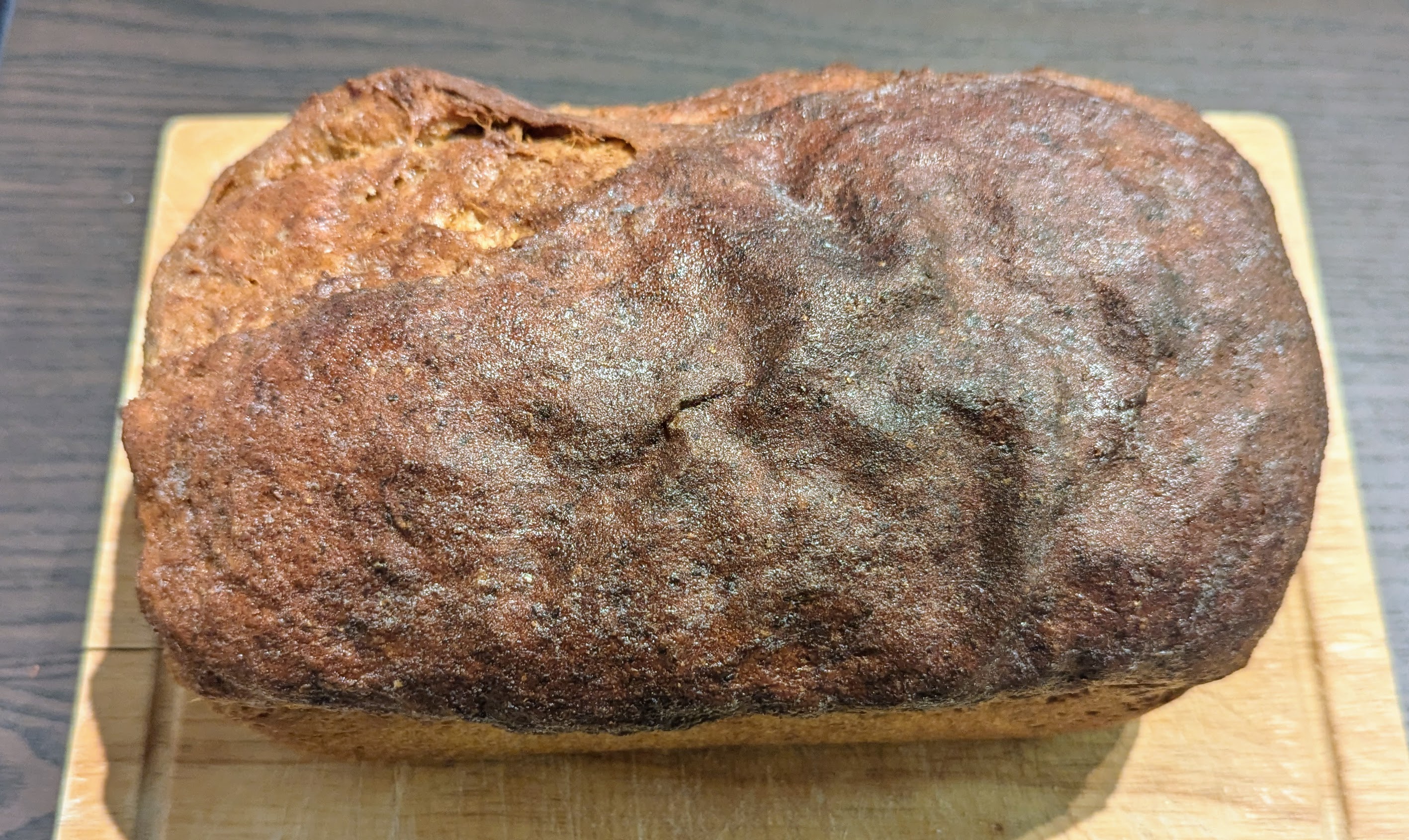
This is a nice, lightly enriched white bread. It's made with an overnight sponge and produces a lovely light loaf. With the twist that it has a line of chocolate running through the centre of the loaves.

The original recipe has it written up as making two petite loaves. I didn't have any loaf pans quite that small (19x9cm), so I decided to add 250g of sourdough starter (to bulk it up a bit and use up some starter). I ended up making one medium (20x10cm) loaf and then turned the rest of the dough into rolls, each one stuffed with a small piece of chocolate.

I think next time I'd use a bit more chocolate in the loaf. It seems to have spread out as the dough rose and resulted in pockets of chocolate rather than a continuous line through the centre as I'd intended.


White Bread with Chocolate

Slightly adapted from Bernard Clayton's New Complete Book of Breads

Ingredients

Sponge

  • 3/4 c. water
  • 2 1/4 tsp. active dry yeast (or 1/2 Tbsp. instant yeast)
  • 1/4 tsp. ground ginger
  • 1 c. hard (strong/high grade/bread) flour
  • 250g sourdough starter @ 100% hydration (optional)

Dough

  • 1/2 c. warm water
  • 1/4 c. dry milk powder
  • 1 Tbsp. sugar
  • 2 tsp. coarse sea salt
  • 2 Tbsp. butter
  • ~400g hard (strong/high grade/bread) flour
  • 150g dark chocolate

Directions

  1. Combine water, yeast, ginger, flour, and sourdough starter (if using).
  2. Mix well, cover, and set aside at room temperature overnight.
  3. In the morning, add the warm water, milk powder, sugar, salt, and butter and stir to combine.
  4. Add the remaining flour, a little at a time, until a soft dough forms.
  5. Turn out onto a well-floured surface and knead for 15-20 minutes, incorporating any remaining flour as necessary.
  6. Round the dough and place in a covered bowl to rise for 60-90 minutes.
  7. Knock the dough back, divide into two equal portions, round each portion, cover, and rest for 5-10 minutes.
  8. Grease two 19x9cm (7.5x3.5") or 20x10cm (8x4") loaf pans, two 20cm (9") square pans, or one of each.
  9. If making loaves: press each dough ball flat, letter fold, place a line of chocolate along the short side, and then roll up around the chocolate. Pinch the seam and ends to seal and place, seam-side-down, into the prepared pans.
    If making rolls: Divide each dough ball into nine equal portions. Press each portion flat and place a small piece of chocolate in the centre of each one. Fold the edges of the rounds up over the chocolate and pinch to seal. Flip the ball over and roll it to form it into a tight ball. Place, seam-side-down in the prepared pan.
  10. Cover and set aside to rise for ~40 minutes.
  11. Preheat oven to 190°C (375°F).
  12. Bake at 190°C (375°F) for 20-30 minutes.
  13. Turn off oven and allow bread to stand in the hot oven for ~5 minutes.
  14. Turn out onto wire rack to cool.
  15. If desired, brush top crusts with a little butter to give it a slightly glossy finish.

Tuesday, 7 October 2025

Banana-Nut Stuffed French Toast

I made a fresh loaf of bread the other day. So then, when I slept in the next morning and wasn't feeling up to doing much for breakfast, I decided to go for this French toast. It's got enough to it to be interesting, but isn't actual complicated or difficult.

It's really meant to be made with a baguette so that you get lots of little slices. But I had just made a full-sized pan loaf, so I used that and just did a few larger slices.


Banana-Nut Stuffed French Toast

Slightly adapted from The Breakfast Bible by Maryana Vollstedt

Ingredients

  • 4 large eggs
  • 3/4 c. milk
  • 1 tsp. vanilla extract
  • 1 loaf of bread (may not need the whole thing)
  • 3-4 bananas, sliced
  • 1/2-3/4 c. chopped walnuts
  • 4-6 Tbsp. brown sugar
  • whipped cream, to serve

Directions

  1. Beat the eggs with the milk and vanilla and pour into a large shallow bowl.
  2. Cut a slice of bread ~1cm (1/2") thick and almost all the way through. Then cut the next "slice" (also ~1cm thick) all the way throgh. (So that you essentially have two slices joined at the bottom.)
  3. Fill the space between the two joined slices with a single layer of banana slices.
  4. Sprinkle in 1-2 Tbsp. of walnuts and 2-3 tsp. of brown sugar.
  5. Heat up a pan over medium-low heat.
  6. Melt a little butter into the pan.
  7. Carefully dip the stuffed bread into the custard. Flip and dip the other side.
  8. Place the dipped bread into the pan and cook until golden-brown on the underside.
  9. Flip and cook until the other side is also nicely browned.
  10. Repeat with additional bread and filling until the custard has been used up.
  11. Serve with whipped cream.

Sunday, 5 October 2025

High-Fibre Bran Loaf

I made a fresh batch of granola yesterday, so I decided to incorporate some of it into this bread. But since the granola was relatively sweet, I only used half the amount and then added pumpkin seeds to fill in the rest of the amount. I would have also liked to have put in some flax seeds, but I couldn't find them, so they didn't make it into this rendition, but I've recommended them so I remember to try to include them next time.


High-Fibre Bread

Slightly adapted from Bernard Clayton's New Complete Book of Breads

Ingredients

  • 280g hard (strong/high grade/bread) whole wheat flour
  • 2 1/4 tsp. active dry yeast
  • 2 tsp. coarse sea salt
  • 2 c. warm water
  • 250g sourdough discard (optional)
  • 1/4 c. butter
  • 2 Tbsp. honey
  • 1/2 c. granola (or 1/4 c. granola + 1/4 c. pumpkin seeds)
  • 2 Tbsp. flax seeds (optional)
  • 1/2 c. wheat germ
  • 1 Tbsp. wheat bran
  • grated zest of 1 orange
  • 400-500g hard (strong/high grade/bread) flour

Directions

  1. Combine the whole wheat flour, yeast, salt, warm water, and sourdough discard (if using) and mix well.
  2. Add the butter, honey, granola, flax seeds (if using), wheat germ, wheat bran, and orange zest and mix thoroughly.
  3. Gradually work in the white flour until a soft dough forms.
  4. Turn the dough out onto a floured surface and knead, working in more flour as needed, for 20-30 minutes.
  5. Shape into a ball and place in a covered bowl to rise (60-90 minutes).
  6. Knock the dough back, divide into two equal portions, and round each one.
  7. Cover and allow to rest for 5-10 minutes.
  8. Meanwhile, grease two 20x10cm (8x4") loaf pans.
  9. Shape the dough balls into loaves and place, seam-side-down, into the prepared loaf pans.
  10. Cover and allow to rise for 30-45 minutes.
  11. Preheat oven to 200°C (400°F).
  12. Bake at 200°C (400°F) for 15-20 minutes.
  13. Reduce temperature to 180°C (350°F) and bake until done (5-15 minutes longer).
  14. Allow to cool in pans for 5-10 minutes, then turn onto wire racks to cool.

Monday, 29 September 2025

Cinnamon Rolls (Breakfast Bible)

This is far from the first cinnamon roll recipe that I've made. But... I hadn't made this recipe yet. And I had the (digital) cookbook with me in NZ. And I needed something for breakfast. I mean, this isn't the healthiest option and should probably be more of a dessert, especially if you include the icing. So, definitely not something to indulge in often, but a nice treat once-in-a-while.


Cinnamon Rolls

Slightly adapted from The Breakfast Bible by Kate McMillan

Ingredients

Dough

  • 1 c. milk
  • 100g sugar
  • 75g butter, melted
  • 3 large eggs
  • 2 1/4 tsp. instant yeast
  • 620g all-purpose flour, divided
  • 1 tsp. coarse sea salt

Filling

  • 100g brown sugar
  • 90g butter, softened
  • 2 tsp. ground cinnamon

Topping

Directions

  1. Combine the milk, sugar, butter, eggs, and yeast.
  2. Add ~550g of the flour and mix well.
  3. Gradually add salt and more flour until a very soft dough forms.
  4. Knead the dough, gradually adding in more flour as necessary, until smooth and supple (~10 minutes).
  5. Shape the dough into a ball and place in a covered bowl to rise (1 1/2-2 hours).
  6. Meanwhile, beat the brown sugar, butter, and cinnamon until combined.
  7. Knock back the dough and roll it out into a large (35x40cm) rectangle.
  8. Spread the filling evenly over the surface of the dough, leaving a 2-3cm border along the longer sides.
  9. Starting with a long side, roll up the dough, jelly-roll-style.
  10. Pinch the edges to seal the seam.
  11. Cut the rolled dough crosswise into 8 or 9 equal slices.
  12. Grease a 23x33cm (9x13") pan.
  13. Arrange the rolls in the prepared pan, cover, and let rise (60-90 minutes at room temperature; up to 12 hours in the fridge).
  14. Preheat oven to 180°C (350°F).
  15. Uncover and bake at 180°C (350°F) until golden brown (~30 minutes).
  16. Let cool in pan for ~15 minutes.
  17. Meanwhile, make the icing.
  18. Spread the icing over the rolls.
  19. Allow to rest for another 15 minutes before serving.

Saturday, 20 September 2025

Royal Hibernian Brown Loaf

I've made many, many different quick breads over the years. Most of them tend to be batter breads though. Soda breads are a bit different. They're made with a chemically leavened dough that gets shaped into a free-form loaf, rather than relying on a pan for shaping. And while I certainly have made soda breads in the past, they're a much less frequent occurence in my kitchen.

This one isn't out of the oven yet, but it smells divine! The scents of the butter and buttermilk really come though. And, although it didn't call for it, I also added ~250g of sourdough starter. Not because I felt that the bread would derive any great benefit from it, but because I desperately needed to use some starter up! Feel free to leave the starter out if you're making this and use the lesser amount of flour. It should be just fine either way. You will just have a slightly smaller (and even richer) loaf without the starter in.


Royal Hibernian Brown Loaf

Slightly adapted from Bernard Clayton's New Complete Book of Breads

Ingredients

  • 350g whole wheat flour
  • 150-200g all-purpose flour
  • 2 Tbsp. sugar
  • 1 tsp. coarse sea salt
  • 1/2 Tbsp. baking soda
  • 1/4 c. butter
  • 1 1/4 c. buttermilk
  • 1 large egg
  • 250g sourdough discard @ 100% hydration (optional)

Directions

  1. Preheat oven to 200°C (400°F).
  2. Grease a baking sheet and dust it with cornmeal.
  3. Combine the flours, sugar, and salt in a large bowl.
  4. Rub in the butter until it is thoroughly combined.
  5. Sift in the baking soda and mix.
  6. Beat the egg with the buttermilk.
  7. Make a well in the centre of the dry ingredients and pour in the buttermilk mixture and the sourdough discard (if using).
  8. Mix thoroughly.
  9. Turn out onto a floured surface and mix by hand to make sure everything is thoroughly incorporated.
  10. Shape into a round ball and place on the prepared baking sheet.
  11. Slash a large X in the top ~1cm deep.
  12. Bake at 200°C (400°F) for 30-40 minutes.

Wednesday, 17 September 2025

Pumpernickel Bread

It's coming up to Thanksgiving here and apparently everyone has been hit by the baking madness. That is to say: The grocery store was completely sold out of 2.5kg bags of white flour when I went to restock the other day. Not a huge problem, but it did mean that I needed to find a whole grain bread recipe to make this week. And, of course, preferably one that I hadn't made before. And this was the first one that I hit upon that I had all the ingredients for.

This recipe makes a lovely, dark, flavourful bread. It came out a bit sweet for my tastes, but still very good nonetheless. I might try reducing the molasses to 1/2 c. next time, just to see how that goes.

As expected, the dough was fairly sticky and challenging to work with due to the high percentage of rye flour, but it did come together eventually. Although it never got quite as supple and elastic as a predominantly wheat dough.


Pumpernickel Bread

Slightly adapted from Bernard Clayton's New Complete Book of Breads

Ingredients

  • 1 3/4 c. water
  • 1/2 c. cornmeal
  • 1/2-3/4 c. molasses
  • 1 Tbsp. butter
  • 1 Tbsp. coarse sea salt
  • 1/2 Tbsp. caraway seeds, bruised/lightly crushed
  • 15g dark chocolate
  • 250g sourdough discard @ 100% hydration (optional)
  • 2 1/4 tsp. active dry yeast
  • 1 c. mashed potatoes
  • 300g rye flour
  • 200-300g hard (strong/high grade/bread) whole wheat flour, divided
  • 1 egg white
  • 1 Tbsp. cold water

Directions

  1. Combine water and cornmeal and bring to a boil.
  2. Reduce heat and simmer until thickened (10-20 minutes).
  3. Remove from heat and stir in molasses, butter, salt, caraway seeds, and chocolate.
  4. Mix in the sourdough starter, yeast and mashed potatoes.
  5. Add the rye flour and ~150g of the whole wheat flour and mix well.
  6. Turn the dough out onto a well-floured surface and knead (the dough will be very heavy, wet, and sticky) for ~20 minutes. Gradually work in the remaining flour while kneading.
  7. Round the dough and place it in a covered bowl to rise.
  8. Once dough is well-risen (60-90 minutes), knock it back and divide into two equal portions.
  9. Round each portionn, cover, and allow to rest for ~10 minutes.
  10. Meanwhile, flour two bannetons (preferably with rice flour).
  11. Shape each portion into a loaf and place, seam-side-up into the floured bannetons.
  12. Cover and allow to rise at room temperature for 45-60 minutes.
  13. Preheat oven to 190°C (375°F).
  14. Grease a baking sheet and dust with cornmeal.
  15. Turn the loaves out onto the the prepared baking sheet.
  16. Beat the egg white with the cold water and brush it onto the loaves.
  17. Bake at 190°C (375°F) for 40-50 minutes.
  18. Turn off oven and allow to stand in hot oven for 5-10 minutes.
  19. Transfer to wire rack to cool.

Sunday, 7 September 2025

Molasses Wheat Bread

I haven't been great at keeping up with the bread baking lately. My poor starter is feeling a bit neglected and we've been largely bread-less over the summer.
I ended up rolling with this recipe today because it was the first one I found that a) I had all the ingredients for and b) didn't require an overnight sponge. And, honestly, it's delicious! I love it. I actually ate two slices immediately. Which I almost never do. And, while I did end up using the mix of white and whole wheat flour that the recipe called for this time, I think it would probably work really well as a 100% whole wheat loaf too!


Molasses Wheat Bread

Slightly adapted from Bernard Clayton's New Complete Book of Breads

Ingredients

  • 2 c. hot water1
  • 1/4 c. molasses
  • 1/2 c. dry milk powder
  • 1 Tbsp. coarse sea salt
  • 450g hard (strong/high grade/bread) whole wheat flour, divided
  • 350-450g hard (strong/high grade/bread) or all-purpose flour, divided
  • 250g sourdough discard @ 100% hydration (optional)
  • 3 Tbsp. butter
  • 4 1/2 tsp. active dry yeast (or ~1 Tbsp. instant yeast)

Directions

  1. Combine the hot water, molasses, milk powder, salt, and ~150g of each of the flours.
  2. Mix well and beat for a minute or two.
  3. Add the sourdough discard (if using) and the butter and beat for another minute.
  4. Add the remaining 300g of whole wheat flour and mix well.
  5. Beat for 2-3 minutes.
  6. Add the yeast and ~150g of the remaining white flour and mix by hand or with a dough hook.
  7. Work in as much of the remaining flour as needed to form a good dough. Flour may be worked in either by hook or by hand.
  8. Knead until dough is supple and elastic (~5 more minutes by hook or 15-20 minutes by hand, depending on the efficiency of your stroke).
  9. Round the dough and place it in a covered bowl to rise (~1 hour depending on room temperature).
  10. Knock the dough back and divide into two equal portions.
  11. Round each one, cover, and rest for 5-10 minutes.
  12. Meanwhile, grease two 20x10cm (8x4") loaf pans.
  13. Working with one portion of dough at a time, press flat and fold into thirds (letter fold). Then, instead of rolling up jelly-roll-style as usual, roll and stretch the dough into a log about 1.5x the length of the loaf pan. Now twist the log once or twice around and place it in one of the prepared loaf pans.
  14. Cover and set aside to rise for ~45 minutes at room temperature.
  15. Preheat oven to 190°C (375°F).
  16. Bake the loaves at 190°C (375°F) until done (30-45 minutes depending on how well-risen they were going in).
  17. If desired, remove from tin for last 5 minutes of baking to give the crust some extra crisp.
  18. Turn off the oven and allow the bread to stand in the hot oven for ~5 minutes.
  19. Turn out of pan and transfer to wire rack to cool.


1 I made my water very hot indeed and then just made sure to add everything else to it before adding the yeast. I was also adding cold sourdough discard out of the fridge which helped to bring the temperature down a bit. Back

Wednesday, 20 August 2025

Lee's Rich Loaf

This is yet another recipe from my time in New Zealand. (Not that I got the recipe in NZ, but I made it for the first time while I was over there and then never got around to writing it up.) This is a nice, enriched white bread. The recipe makes enough dough for two loaves. Meanwhile, there is enough filling for one. So, in a single batch, you get a plain white sandwich bread as well as a lovely dessert loaf, replete with nuts and cinnamon!

Photo goes here.

Lee's Rich Loaf

Slightly adapted from Bernard Clayton's New Complete Book of Breads

Ingredients

Dough

  • 1 tsp. coarse sea salt
  • 1/4 c. sugar
  • 1/4 c. butter
  • 1 1/4 c. water
  • 1/3 c. dry milk powder
  • ~700g hard (strong/high grade/bread) flour
  • 2 1/4 tsp. active dry yeast
  • 2 large eggs

Filling

  • 1/4 c. chopped walnuts or pecans
  • 1/4 c. raisins, soaked and drained
  • 1 tsp. ground cinnamon
  • 2 Tbsp. brown sugar
  • 2 tsp. grated orange zest
  • 1 Tbsp. butter, melted

Directions

  1. Combine salt, sugar, butter, water, and milk powder over low heat and cook until butter is melted and water is very warm, but do not allow to boil.
  2. Place ~250g of the flour into a bowl, pour in the warm liquid, and mix well.
  3. Double check the temperature to make sure it's not too hot. Batter should be no more than 50°C.
  4. Add the yeast and mix well.
  5. Stir in the eggs, then beat for 2-3 minutes.
  6. Add the most of the remaining flour a little bit at a time until a rough, shaggy dough forms.
  7. Turn out onto a lightly floured work surface and knead, using any remaining flour to dust as necessary to keep it form being excessively sticky. Be very careful not to add too much flour! The dough should remain soft and pliable.
  8. Continue kneading for 10-20 minutes.
  9. Round the dough and place it in a covered bowl to rise for ~1 hour at room temperature.
  10. Once the dough is well-risen, knock it back and knead a few strokes.
  11. Divide into two equal portions and round each one.
  12. Cover and rest for ~10 minutes.
  13. Meanwhile, combine the nuts, raisins, cinnamon, sugar and orange zest in a bowl and mix well.
  14. Grease two 20x10cm (8x4") loaf pans.
  15. Take one of the dough balls and press/roll it into a flat rectangle ~35cm (14") long and ~1cm (1/2") thick.
  16. Brush the melted butter onto the dough, leaving a 1-2cm margin where the seam will be.
  17. Sprinkle the filling mixture over the butter.
  18. Carefully roll the dough into a log and pinch to seal.
  19. Place the loaf, seam-side-down, into one of the prepared loaf pans.
  20. Shape the other dough ball into a loaf by your preferred shaping method and place it in the remaining empty loaf pan.
  21. Cover and set aside to rise for ~45 minutes.
  22. Preheat oven to 200°C (400°F).
  23. Bake at 200°C (400°F) for 15 minutes.
  24. Reduce temperature to 180°C (350°F) and keep baking for an additional 10-20 minutes.
  25. Turn out onto baking rack to cool.

Saturday, 16 August 2025

Orange Marmalade Bread Pudding

This purports to be a breakfast. But I would definitely class it as more of a dessert. It's very tasty. But it's basically all starch (with some sugar and fat thrown in for good measure). So I definitely wouldn't normally want to serve it for breakfast. Especially not as the sole offering. It's simultaneously too rich and yet not filling enough. But it does make for a lovely treat along with or after a meal.

Photo goes here.

Orange Marmalade Bread Pudding

Slightly adapted from The Breakfast Bible by Kate McMillan

Ingredients

  • 3 Tbsp. butter
  • 1 loaf (~450g) bread (preferably brioche or challah), ends trimmed and sliced
  • 5 large eggs
  • 1 large egg yolk1
  • 2 c. milk
  • 3/4 c. heavy (35%) cream
  • 70g sugar
  • 1 tsp. vanilla extract
  • 1/4 tsp. coarse sea salt, ground
  • 1/8 tsp. ground cinnamon
  • 1/8 tsp. ground nutmeg
  • 1/2 c. orange marmalade
  • whipped cream, to serve (optional)

Directions

  1. Grease a 23x33cm (9x13") baking dish.
  2. Spread the butter over the bread slices, then cut the slices in half and layer them (overlapping slightly) into the prepared baking dish.
  3. Beat the eggs with the yolk, milk, cream, sugar, vanilla, salt, cinnamon, and nutmgeg.
  4. Pour the egg mixture over the bread slices.
  5. Let stand for ~30 minutes, pressing the bread down into the custard periodically.
  6. Meanwhile, preheat oven to 160°C (325°F).
  7. Bake at 160°C (325°F) for 30-35 minutes.
  8. Meanwhile, gently warm the marmalade over low heat, stirring often.
  9. Remove the pudding from the oven and brush it with the warm marmalade.
  10. Return to oven and bake for another 10-15 minutes.
  11. Remove from oven and let stand for 10-15 minutes before serving.
  12. Serve with fresh fruit and/or whipped cream.


1 The original recipe called for making a richer custard using 3 large eggs and 5 yolks. I didn't want to have to deal with that many surplus egg whites on this occasion though, so I adjusted it to use more whole eggs and just the one extra yolk. Back

Monday, 4 August 2025

Pusstabrot (Hungarian White Bread)

This is a lovely white bread with a nice bit of extra flavour from the fennel seeds. I really liked it.


Pusstabrot

Slightly adapted from Bernard Clayton's New Complete Book of Breads

Ingredients

  • 1/2 tsp. fennel seeds
  • 600-700g hard (strong/high grade/bread) flour, divided
  • 2 tsp. coarse sea salt
  • 2 Tbsp. sugar
  • 1 1/2 c. hot (50-55°C) water
  • 2 Tbsp. oil
  • 4 1/2 tsp. active dry yeast
  • 1 egg white
  • 1 tsp. water

Directions

  1. Gently roast the fennel seeds in a small frying pan.
  2. Remove from heat and allow to cool completely, then grind with a mortar and pestle.
  3. Combine ~400g of the flour with the salt, sugar, and ground fennel.
  4. Stir to combine, then make a well in the centre.
  5. Pour the hot water and oil into the well and sprinkle in the yeast.
  6. Use a wooden spoon to stir the liquids from the centre, gradually pulling in just enough of the flour to form a thin batter.
  7. Cover and set aside until the batter rises to cover the rest of the flour (~1 hour).
  8. Once the batter has risen, uncover and begin stirring from the centre outward, gradually working in the rest of the flour.
  9. Work in a bit more flour (100-200g) to stop the dough from being too sticky.
  10. Turn out the dough and knead until smooth and elastic (10-20 minutes), working in the rest of the flour as needed to form a soft and supple dough.
  11. Round the dough and return it to a covered bowl to rise (~1 hour).
  12. Knead the dough for a few strokes, then shape as desired. This recipe will make either one large or two small loaves.
  13. Place the shaped loaves on a greased baking sheet, cover, and set asdie to rise for 30-40 minutes.
  14. Preheat oven to 180°C (350°F) and place a pan of boiling water on the bottom rack.
  15. Beat the egg white with the water and a pinch of salt.
  16. Brush the loaves with the egg white mixture and slash as desired.
  17. Sprinkle with extra fennel seeds
  18. Bake at 180°C (350°F) until done. This may take anywhere from 20-50 minutes depending on whether you are baking one loaf or two and how well-risen they are.
  19. Turn off oven, remove steam pan, and let loaves rest in hot oven for 5-10 minutes.
  20. Transfer to wire rack to cool.

Tuesday, 29 July 2025

Apple Strata

I'm used to stratas being savoury dishes. Layers of bread, maybe some sausage and/or veggies, probably cheese, and then eggs or custard to bind it all together. Baked up into a tasty breakfast dish.

This one is a bit different. It's a sweet strata! Basically a layered bread pudding. Full of apples, raisins, spices, and a lightly sweetened custard. And served with maple syrup. Rather than cheddar or mozzarella (as I might normally expect for a strata), it uses cream cheese.

I think, on the whole, I prefer my savoury stratas. But this was definitely a nice way to mix things up a bit. And the Kidlet loved it!


Apple Strata

Slightly adapted from The Big Book of Breakfast by Maryana Vollstedt

Ingredients

  • 6 slices stale bread, cubed and divided
  • 125g cream cheese, cubed
  • 2 apples, peeled and diced
  • 1/2 c. raisins
  • 6 large eggs
  • 1 1/4 c. milk
  • 1 Tbsp. brown sugar
  • 1 tsp. ground cinnamon
  • 1/4 tsp. ground nutmeg
  • 1/8 tsp. ground cloves

Directions

  1. Grease a 23x23cm (9x9") square pan.
  2. Place half of the bread cubes in an even layer in the bottom of the pan.
  3. Scatter the cream cheese on top.
  4. Layer the apples on top of this and sprinkle with the raisins.
  5. Beat the eggs with the milk and mix in the sugar, cinnamon, nutmeg, and cloves.
  6. Pour the custard over the strata.
  7. Cover and set aside to allow the bread to soak up the custard for at least an hour and as long as overnight. (Store in the fridge if there will be more than 2 hours between assembly and baking.)
  8. Preheat oven to 180°C (350°F)1.
  9. Bake strata at 180°C (350°F) until custard is just set (60-75 minutes).
  10. Serve topped with icing sugar and/or maple syrup.


1 The original recipe says to bake your strata at 190°C (375°F) for 55 minutes. Mine was very dark on top after only 45, but still raw in the centre. I ended up covering it with foil and baking it for another 10 minutes and then reducing the temperature to 180°C (350°F) and baking it 10 more minutes. So, I think next time I'd just start it out at 180°C (350°F) and bake it for a bit longer to make sure that everything gets cooked through without burning. Back

Sunday, 27 July 2025

Eggs Baked in Brioche

I didn't quite do this recipe to spec. It's very simple. You're meant to cut the topknots off of a few individual brioches, hollow out the larger bottom parts, butter both, and then bake eggs in the bases. They're seasoned with a little tarragon and parsley. But there's not much to them other than that.

So how, with a recipe so simple, could I have deviated? Well... I still had about half of this lovely poppyseed bubble loaf left. And some of the centre bits were ever so slightly underbaked. So it occurred to me that this might be the ideal way to use them! Hollow them out, fill them with eggs, and bake them again. Which is great, except the "bubbles" are all a bit smaller and much more awkwardly and irregularly shaped than a traditional brioche. So the eggs didn't really fit neatly into them. I did my best. But it still got a bit messy.


Eggs Baked in Brioche

Slightly adapted from The Big Book of Breakfast by Maryana Vollstedt

Ingredients

  • 4 individual brioches
  • 1-2 Tbsp. butter, melted
  • 4 large eggs
  • salt and pepper, to taste
  • 1/2 tsp. dried tarragon
  • 4 tsp. chopped flat-leaf parsley

Directions

  1. Preheat oven to 180°C (350°F) and butter 4 custard cups or ramekins.
  2. Cut the topknots off the brioches and set them aside.
  3. Hollow out the brioche bases and butter them.
  4. Crack and egg into each brioche base.
  5. Sprinkle with salt, pepper, tarragon, and parsley.
  6. Bake at 180°C (350°F) for 10 minutes.
  7. Meanwhile, butter the topknots, wrap in foil, and set aside.
  8. Once the eggs have been in the oven for 10 minutes, add the foil packet with the topknots and continue baking for another 10 minutes.
  9. Remove from oven and serve.

Wednesday, 23 July 2025

Poppyseed Bubble Loaf

I've been meaning to make this one for a while now. It can be done as either a "bubble loaf" with little round balls of dough coated in poppyseeds or "money bread" with flat ribbons of dough coated in brown sugar and currants. I opted for the savoury poppyseed variety.

The recipe specifies using 2 cups of butter for coating the dough pieces. This is clearly insane. I melted 1 stick (ie. 1/2 a cup) and still had about half of it left over by the time I was done. Two cups would've been ludicrous!

Otherwise, I pretty much followed the recipe. Although I did toss in ~250g of sourdough discard. Not because the recipe needed it, but because the starter desperately needed to be fed. And, to be honest, the starter does act as a decent conditioner that makes the dough a bit nicer and the finished bread a bit more resistant to going stale, so... why not?

And, while I kept the rest of the ingredients the same, I did slightly change the way that I handled some of them. Most notably, I omitted the butter until I was about halfway through kneading the dough and then worked it in. My understanding is that, although it doesn't necessarily make a huge difference, this can often help with gluten formation.


Poppyseed Bubble Loaf

Slightly adapted from Bernard Clayton's New Complete Book of Breads

Ingredients

  • 800-900g hard (strong/high grade/bread) flour, divided
  • 2 1/4 tsp. active dry yeast
  • 250g sourdough discard (optional)
  • 2 c. water
  • 2 tsp. coarse sea salt
  • 2 Tbsp. sugar
  • 2/3 c. dry milk powder
  • 6-8 Tbsp. butter, divided
  • 1/3 c. poppyseeds

Directions

  1. Combine the yeast with 400g of the flour.
  2. Add the sourdough discard (if using) and the water and stir to combine.
  3. Add the salt, sugar, and milk powder and mix vigorously for ~150 strokes.
  4. Add 400g of the remaining flour ~50g at a time.
  5. Turn the dough out and knead for 5-10 minutes, using the remaining flour to dust as needed to achieve a soft, supple dough that does not stick too much.
  6. Smear 2 Tbsp. of the butter on the work surface and work the dough on top of it for another 5-10 minutes, grandually working the butter into the dough.
  7. Knead until dough is smooth and elastic. Small bubbles forming just below the surface is an excellent sign!
  8. Round the dough and place it in a covered bowl to rise at room temperature.
  9. Once dough is fully risen (~1 hour), knock it back.1
  10. Melt the remaining butter and use some of it to grease a large (10-cup) Bundt pan.
  11. Place the poppyseeds in a shallow dish.
  12. Pinch off a small portion of dough, shape it into a ball, dip it in the melted butter, and then dip it in the poppyseeds. Place the ball seed-side-up in the prepared pan.
  13. Repeat with remaining dough.
  14. Cover and let rise for 30-45 minutes.
  15. Preheat oven to 180°C (350°F).
  16. Bake at 180°C (350°F) until done.2


Variations

Monkey Bread

Ingredients

  • 800-900g hard (strong/high grade/bread) flour, divided
  • 2 1/4 tsp. active dry yeast
  • 250g sourdough discard (optional)
  • 2 c. water
  • 2 tsp. coarse sea salt
  • 2 Tbsp. sugar
  • 2/3 c. dry milk powder
  • 6-8 Tbsp. butter, divided
  • 1/4 c. brown sugar
  • 1/2 c. currants, soaked and drained

Directions

  1. Make the dough as directed above.
  2. Once ready for shaping, press or roll the dough into a large, flat rectangle and cut into ribbons ~2cm wide and 8cm long.
  3. Mix the brown sugar and the currants into the melted butter.
  4. Dip the dough ribbons into the butter mixture and toss into the pan. (Clayton says to do this "haphazardly", but I think that trying to make a nice pattern with them would be pretty.)


1 At this point, you're meant to begin shaping the loaf. I had errands to run, however, so I asked TF to knock the dough back at the 1-mark and then put it back in its bowl to complete a second rise there. After an additional hour, I knocked it back a second time and then shaped the loaf. So the final proof was actually it's third rise, rather than the second as called for in the original recipe. Doing it this way certainly doesn't seem to have hurt the results any! So, feel free to adjust the rises to suit your schedule. Putting it in the fridge to retard it somewhat could also be an option. Bread is really quite flexible! Figure out a method that works for you. Back
2 This can be a little tricky to judge with this loaf. Clayton actually says to bake it at 190°C (375°F) for 1 hour. I thought that sounded excessive. Especially for how well-risen the loaf was. I also worried that the slightly higher oven temperature would cause it to burn on the outside before it had baked through in the centre. So I lowered the temperature to 180°C (350°F) and baked it for just 30 minutes. The top pieces were certainly wonderfully browned and beautifully baked. Hopefully it ended up fully cooked in the centre as well. I will admit, I did not end up testing it as I was a little distracted by the time it was going in the oven. Back

Tuesday, 8 July 2025

Old Milwaukee Rye

I don't tend to make very many rye breads. I find the low-gluten flour difficult to work with and I still haven't mastered the technique. This one came out quite nicely though! It takes a while to get it going. The sour needs to ferment over three days. But it's worth the wait!

Old Milwaukee Rye

Slightly adapted from Berndard Clayton's New Complete Book of Breads

Ingredients

Sponge

  • 250g rye flour
  • 2 1/4 tsp. active dry yeast
  • 1 Tbsp. caraway seeds
  • 2 c. warm water (~40°C)

Dough

  • 1 c. hot water (~50°C)
  • 1/4 c. molasses
  • 2 Tbsp. caraway seeds, divided
  • 2 large eggs, divided
  • 1 Tbsp. coarse sea salt
  • 250g rye flour
  • ~500g hard (strong/high grade/bread) flour
  • 3 Tbsp. butter
  • 1 Tbsp. milk

Directions

  1. Combine the flour, yeast, caraway, and water for the sponge and beat for a minute or two.
  2. Cover the bowl tightly and set aside at room temperature to ferment for 6-72 hours, stirring once every 24 hours.
  3. Once ready to bake, add the hot water, molasses, 1 Tbsp. of the remaining caraway seeds, 1 of the eggs, and salt to the sponge.
  4. Stir in the remaining rye flour and ~250g of the white flour.
  5. Beat for 3-4 minutes, then mix in the butter.
  6. Work in the remaining white flour a little at a time.
  7. Turn the dough out onto a floured surface and knead for 10-20 minutes until smooth.
  8. Round the dough and place it in a covered bowl to rise (~1 hour).
  9. Knock the dough back, allow to rest for 5-10 minutes.
  10. Divide the dough into two equal portions and round each one.
  11. Cover and rest for another 10 minutes.
  12. Grease a baking sheet and dust it with cornmeal.
  13. Shape each loaf as desired. If you have bannetons, then a standard letter fold + coil fold works well. If not, then I like to do a letter fold and then round them again. Or do a letter fold and then fold in half lengthwise and pinch the seam together.
  14. If using bannetons, place the loaves seam-side-up in the bannetons. If no bannetons are available, place the shaped loaves directly on the prepared baing sheet (seam-side-down).
  15. Cover and allow to rise at room temperature for ~45 minutes or as long as overnight in the fridge.
  16. Preheat oven to 190°C (375°F).
  17. If the loaves have been rising in bannetons, turn them out onto the prepared baking sheet now.
  18. Beat the remaining egg with the milk.
  19. Brush the tops of the loaves with the egg mixture and sprinkle with the remaining caraway seeds.
  20. Slash as desired. (3-4 diagonal slashes for long loaves or a # pattern for round.)
  21. Bake at 190°C (375°F) for 35-45 minutes.
  22. Turn off oven and allow to stand in hot oven for 5-10 minutes.
  23. Transfer to wire rack to cool.

Saturday, 5 July 2025

Sesame-Nut Bread

This bread uses a generous quantity of sesame oil in the dough, has walnuts folded in, and is topped with toasted sesame seeds. Unfortunately, I was a bit out of it when making it, so I forgot to add the walnuts before doing the preshaping like I was supposed to. Given that the dough was already divided, I decided to just add half the quantity of walnuts to half of the dough and leave the other one with just the sesame seeds. And, I have to admit, the one without the walnuts rose better and came out with a nicer shape. I think, if I were doing it again, I'd like to try a pure sesame loaf: sesame oil, sesame seeds folded into the dough, and sesame seeds on top.


Sesame-Nut Bread

Slightly adapted from Bernard Clayton's New Complete Book of Breads

Ingredients

  • 1 1/2 c. water
  • 2 Tbsp. sesame oil
  • 1 Tbsp. canola (or other neutral) oil
  • 1/4 c. honey
  • 250g sourdough discard (optional)
  • 450g hard (strong/high grade/bread) whole wheat flour, divided
  • 1 Tbsp. coarse sea salt
  • 1/2 c. dry milk powder
  • 4 1/2 tsp. active dry yeast
  • 2 large eggs
  • 150g hard (strong/high grade/bread) flour
  • 1 c. chopped walnuts (or 1/2 c. toasted sesame seeds)
  • 1 small egg
  • 1 Tbsp. milk
  • 2 Tbsp. toasted sesame seeds

Directions

  1. Combine water, sesame oil, canola oil, and honey and heat to ~50°C (120°F).
  2. Add the sourdough discard (if using) and 300g of the whole wheat flour and stir vigorously for ~100 strokes.
  3. Add the remaining whole wheat flour, salt, milk powder and stir for another 100 strokes.
  4. Cover and set aside for 30-60 minutes.
  5. Add the yeast and mix in the 2 large eggs.
  6. Work in the white flour, a little at a time.
  7. Turn out onto a well-floured surface and knead for at least 20 minutes, working in small amounts of extra flour as needed to stop dough from being excessively sticky.
  8. Round the dough and place in a covered bowl to rise (60-90 minutes).
  9. Knock the dough back and work in the walnuts (or sesame seeds).
  10. Divide the dough into two equal portions and round each one.
  11. Cover and rest for ~10 minutes.
  12. Grease two 20x10cm (8x4") loaf pans.
  13. Shape each dough portion into a loaf and place into pans.
  14. Cover and allow to rise for 45-60 minutes.
  15. Preheat oven to 190°C (375°F).
  16. Beat the small egg with the milk and brush the tops of the loaves with the mixture.
  17. Sprinkle with sesame seeds.
  18. Bake at 190°C (375°F) until done (~30 minutes).
  19. Run a knife or a spatula around edges of pans and carefully turn loaves out.
  20. Return to hot (but turned off) oven for 5-10 minutes, then transfer to wire rack to cool.

Monday, 16 June 2025

Hilo Bran Bread

I needed bread in a hurry last night. I had intended to give the chocolate bread a try when next I was baking, but I didn't have time to make the sponge. So instead I flipped a bit further through the book and settled on this high-fibre quick bread recipe.

Using chemical leaveners rather than yeast meant it was ready in about an hour. And, while it does have quite a bit of sugar in it, it also contains a hefty quantity of wheat bran and no added fat. So it comes out sweet, but quite lean. And the molasses makes it pleasingly dark and fragrant.


Hilo Bran Bread

Slightly adapted from Bernard Clayton's New Complete Book of Breads

Ingredients

  • 375g flour
  • 150g wheat bran
  • 1/2 c. sugar
  • 1 tsp. coarse sea salt, ground
  • 4 tsp. baking powder
  • 1 tsp. baking soda
  • 2 1/2 c. milk
  • 6 Tbsp. molasses

Directions

  1. Preheat oven to 180°C (350°F) and grease and flour two 20x10cm (8x4") loaf pans.
  2. Combine the flour, bran, sugar, and salt.
  3. Sift in the baking powder and baking soda and mix well.
  4. In a large measuring cup, combine the milk and molasses and mix well.
  5. Pour the wet ingredients into the dry and stir to combine.
  6. Pour the batter into the prepared pans and let stand for 10 minutes.
  7. Bake at 180°C (350°F) for 40-45 minutes.
  8. Turn out onto wire racks to cool.

Wednesday, 11 June 2025

Wheat Germ Bread

As has become typical recently, this write-up is late. I made this bread several weeks ago, but it's taken me a while to get to the write-up for it.

It was a fine loaf. Very wheat-y. As you might expect from something containing so much extra wheat germ. But it rose well and the flavour was nice. It wasn't special, but it was perfectly serviceable and we've eaten the lot now.


Wheat Germ Bread

Slightly adapted from Bernard Clayton's New Complete Book of Breads

Ingredients

  • 1 3/4 c. water
  • 1 Tbsp. sugar
  • 2 tsp. coarse sea salt
  • 1/3 c. butter
  • 1/3 c. molasses
  • 4 1/2 tsp. dry active yeast
  • 1 c. wheat germ
  • 3/4 c. milk, warmed to ~50°C (120°F)
  • 600g hard (strong/high grade/bread) whole wheat flour
  • 200-300g hard (strong/high grade/bread) flour

Directions

  1. Combine the water, sugar, salt, butter, and molasses and warm to ~40°C (105°F).
  2. Add the yeast and set aside.
  3. In a separate bowl, combine the wheat germ with the warm milk and set aside until liquid is absorbed and mixture has cooled slightly.
  4. Add the molasses mixture to the wheat germ mixture.
  5. Add ~300g of the whole wheat flour and 125g of the white flour and stir vigorously for 150-200 strokes.
  6. Add the remaining whole wheat flour and mix very well.
  7. Use some of the remaining white flour to dust your work surface and turn the dough out onto it.
  8. Knead, working in as much of the remaining flour as needed to form a soft, supple dough. (If in doubt, it's better for the dough to be a bit too loose than a bit too tight.)
  9. Continue kneading for another 10 minutes or so.
  10. Round the dough and place it in a covered bowl to rise at room temperature for 60-90 minutes.
  11. Knock back, knead a few strokes, divide into two equal portions, and round each one.
  12. Cover and let rest for 5-10 minutes.
  13. Meanwhile, grease two 22x12cm (8.5x4.5") loaf pans.
  14. Shape the loaves by your preferred method (I like to do a letter fold followed by a coil fold) and place them, seam-side-down, into the prepared tins.
  15. Cover and let rise at room temperature for 45-75 minutes.
  16. Preheat oven to 190°C (375°F).
  17. Bake loaves at 190°C (375°F) for 30-40 minutes.
  18. Remove from oven and let cool in tins for 5-10 minutes.
  19. Brush crusts with a little butter if desired. (It will give them a light gloss.)
  20. Turn out onto wire racks to finish cooling.

Sunday, 2 February 2025

Hearty White Bread

This bread gives a very "one of everything I can see in the pantry sort of vibe" while still being a relatively plain white bread. It doesn't contain any whole grains, seeds, or fruit. And yet it has pretty much everything else you could put into a bread in it. In addition to the white flour, salt, and yeast that you would expect in a white sandwich bread like this; it also gets instant potato flakes, dry milk powder, eggs, sugar, oil, and wheat germ added to the mix! Which makes for a fairly interesting loaf even though it doesn't really any visible inclusions.


Hearty White Bread

Slightly adapted from Bernard Clayton's New Complete Book of Breads

Ingredients

  • 450g hard (strong/high grade/bread) flour, divided
  • 1/2 c. wheat germ
  • 1/2 c. instant potato flakes
  • 1/4 c. dry milk powder
  • 2 Tbsp. sugar
  • 2 tsp. coarse sea salt
  • 4 1/2 tsp. active dry yeast (or 1 Tbsp. instant yeast)
  • 125g sourdough discard (optional)
  • 2 large eggs
  • 1 c. warm water
  • 2 Tbsp. oil

Directions

  1. Combine ~250g of the flour with the wheat germ, potato flakes, milk powder, sugar, walt, and yeast and mix well.
  2. Add the sourdough discard, eggs, and water and stir vigorously for ~150 strokes.
  3. Mix in the oil.
  4. Add the remaining flour a little at a time until the dough comes together.
  5. Turn out and knead for 10-15 minutes.
  6. Round and place in a covered bowl to rise for ~1 hour.
  7. Knock back, round, cover, and rest for ~10 minutes.
  8. Meanwhile, grease a large (23x13cm/9x5") loaf pan.
  9. Shape the loaf by your preferred method and place, seam-side-down, into the prepared pan.
  10. Cover and proof for 30-45 minutes.
  11. Preheat oven to 200°C (400°F).
  12. Uncover and bake at 200°C (400°F) for 15 minutes.
  13. Reduce oven temperature to 180°C (350°F) and bake until done (~20 minutes).
  14. Turn out onto a wire rack to cool.

Wednesday, 29 January 2025

Bacon and Cheese Strata

I think this is the most barebones strata that I've ever seen. That's not bad, mind you! It honestly really hit the spot this morning. And the simplicity means that you don't need to worry about having a lot of ingredients on hand to make it. Plus, the relatively plain flavour makes it the perfect backdrop for whatever sauces or toppings you want to use to dress it up. So, I really have no complaints about it. It was just interesting to see a strata that was pretty much just bread, custard, and cheese with just a touch of bacon to round it out. Not a bad place to start your breakfast or brunch though, really. Very handy as a goes-with-anything sort of dish!


Bacon and Cheese Strata

Slightly adapted from The Big Book of Breakfast by Maryana Vollstedt

Ingredients

  • 4 slices bread
  • 100-150g bacon, cooked and chopped
  • 6 large eggs
  • 1 1/2 c. milk
  • 1/4 tsp. coarse sea salt, ground
  • 1/8 tsp. black peppercorns, ground
  • 2-3 drops Tabasco (or similar) hot sauce
  • 2 Tbsp. chopped flat-leaf parsley1
  • 1/2 c. grated cheddar cheese

Directions

  1. Grease a 20x30cm baking dish.
  2. Arrange the bread slices in a single layer in the bottom of the dish. Trim as needed to get them to fit with as few gaps as possible.
  3. Sprinkle the bacon over the bread.
  4. Beat the eggs with the milk and mix in the salt, pepper, Tabasco sauce, and parsley.
  5. Pour the custard over the bread, cover, and set aside for at least half an hour. Alternatively, cover, and chill overnight.
  6. Preheat oven to 180°C (350°F).
  7. Sprinkle the cheese over the strata.
  8. Bake at 180°C (350°F) for 30-40 minutes.
  9. Serve with HP Sauce and/or your favourite chutney.


1 I completely forgot to add the parsely! Whoops! Still tasty, but wish I'd remembered that detail. Oh well... next time! Back

Saturday, 25 January 2025

Feather Bread (Bernard Clayton)

"Feather bread" -- not to be confused with the featherpuff bread from Laurel's Kitchen -- is a fairly plain (but quite serviceable) basic, white bread from Bernard Clayton's bread book. Although he recommends baking the loaves as baguettes, I didn't feel like trying to shape the long, skinny loaves, so I made a couple of slightly plump batards instead.

The dough itself is lightly enriched with a small amount of sugar and a much larger quantity of butter. And the crust develops a lovely shiny sheen from the egg white glaze applied just before baking.

I found the flavour of the final bread somewhat bland. But it did work very well for sandwiches. And the crumb was very nice with excellent texture. And the loaves did look quite pretty. So, definitely worth making. But possibly not a bread to enjoy on its own. It works better as a substrate or sandwich component than as a stand-alone starch.


Feather Bread

Slightly adapted from Bernard Clayton's New Complete Book of Breads

Ingredients

  • 500-550g hard (strong/high grade/bread) flour, divided
  • 1 Tbsp. instant yeast
  • 1 Tbsp. sugar
  • 1 Tbsp. coarse sea salt
  • 1 1/2 c. water @ 50°C
  • 1/4 c. unsalted butter
  • 1 egg white
  • 1 Tbsp. water

Directions

  1. Combine ~375g of the flour with the yeast, sugar, and salt and mix well.
  2. Pour in the water and stir to combine.
  3. Mix vigorously for 150-200 strokes (or a couple of minutes with the flat beater in a stand mixer).
  4. Mix in the butter.
  5. Mix in the remaining flour, a bit at a time, until the dough comes together.
  6. Turn out onto a lightly floured surface and knead until smooth, supple, and elastic (10-20 minutes).
  7. Round the dough and place in a covered bowl to rise. The first rise should take ~1 hour at room temperature.
  8. Once fully risen, knock the dough back and divide into two equal portions.
  9. Round each portion, cover, and rest for ~10 minutes.
  10. Meanwhile, grease a baking sheet and dust it with cornmeal.
  11. Shape each portion into a batard and place on the prepared baking sheet.
  12. Cover and allow to rise at room temperature. The second rise should take ~45 minutes at room temperature.
  13. Preheat oven to 220°C (425°F).
  14. Beat the egg white with the water and brush the mixture over the surface of both loaves, being careful not to let the glaze drip onto the pan.
  15. Slash the loaves as desired.
  16. Bake at 220°C (425°F) until shiny and nicely browned (15-20 minutes).
  17. Test loaves for doneness. If they're not quite done yet, reduce oven temperature to 180°C (350°F) and continue baking until done (likely 5-10 minutes longer).
  18. Turn off oven and allow loaves to stand in hot oven for 5-10 minutes.
  19. Remove from oven and transfer to wire rack to cool.