Showing posts with label daikon. Show all posts

Friday, 9 December 2022

Galbijjim (Braised Short Ribs)

I've been wanting to try this recipe for a while now. I was really surprised to see how much fruit it contained! You want me to make the sauce/gravy for my beef stew out of apples, pears, and kiwi? Really?! But it's great!

We'd already eaten this year's supply of beef ribs by the time I was making this, so I ended up cutting up a sirloin steak to go in the pot instead. I realize that this doesn't really give you the authentic galbijjim experience, but it's what I had available and I'm pretty happy with the results.


Galbijjim

Slightly adapted from Aaron & Claire

Ingredients

  • 900g Korean (brown) or Asian (yellow) pear
  • 250g sweet apple (such as fuji or ambrosia)
  • 150g kiwi
  • 1 yellow onion (1/2 if it's large)
  • 6 green onions (scallions), divided
  • 3 c. water, divided
  • 1/2 c. light (regular) soy sauce
  • 1 Tbsp. oyster sauce
  • 1 Tbsp. dark soy sauce
  • 1/2 Tbsp. dasida (Korean beef stock powder)
  • 3 Tbsp. mirin
  • 3 Tbsp. sugar
  • 1 Tbsp. sesame oil
  • 1/2 tsp. black peppercorns, ground
  • 1.2kg bone-in beef short-ribs
  • 300g daikon
  • 200g carrot
  • 125g fresh shiitake mushrooms
  • 5 shishito peppers
  • 1 red chile pepper, thinly sliced (optional)

Directions

  1. Peel the pear, apple, kiwi, and onion and cut into large pieces.
  2. Place pear, apple, kiwi, onion, and 2 of the green onions in a blender with 1 c. of the water.
  3. Blend until smooth.
  4. Add the light soy, oyster sauce, dark soy, dasida, mirin, sugar, sesame oil, and pepper to the blender and mix well.
  5. Bring some water to a boil and blanch the ribs for 3-5 minutes.
  6. Drain the ribs and return them to the pot.
  7. Add the sauce from the blender.
  8. Swish out the blender with the remaining 2 c. of water and add it to the pot with the ribs.
  9. Bring to a boil.
  10. Reduce heat to medium and cook, uncovered, for 50-60 minutes.
  11. Meanwhile, peel the daikon and carrots and cut them crosswise into 2cm pieces. Bevel the edges of the pieces if you'd like to be extra fancy.
  12. Clean and trim the shiitakes. Put some decorative cuts in the caps if you'd like.
  13. Chop the remaining 4 green onions and halve and deseed the shishito peppers.
  14. Once the beef has cooked for 50-60 minutes, add the daikon and cook for another 10-15 minutes.
  15. Add the carrot and mushrooms and cook until sauce reaches desired consistency (15-20 minutes).
  16. Add the green onions, shishito peppers, and red chile (if using).
  17. Serve with rice.

Monday, 28 February 2022

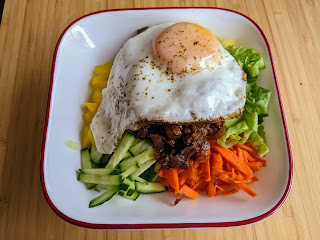
Bibimbap (Mixed Rice)

I love bibimbap. It's the dish that introduced me to Korean food and it's still one of my favourites. But it's always been one of those things that I only ever get from restaurants. I've never made my own bibimbap at home. As usual though, Aaron makes things easy and approachable and my first foray into homemade bibimbap was a huge success. TF and I both loved it and so did the Kidlet. She said it was a "super favourite" and asked for it in her lunch tomorrow as well.

I played a bit fast-and-loose with the vegetables and toppings, but you can get away with doing that with dishes like this. Aaron recommended carrots, zucchini, shiitake mushrooms, lettuce, salted daikon with gochugaru, soy bean sprouts, cucumbers, saucy ground beef, and a sunny side up egg. We didn't have the zucchini, bean sprouts, or any fresh daikon, so we swapped them out for bell pepper and danmuji (pickled daikon). And we swapped out the ground beef for chopped, thinly sliced beef. Really though, I think as long as you have rice, at least a few different veggies, some protein (meat, tofu, tempeh, seitan, etc.), and an egg... you're good to go! Make it what you want.


Bibimbap

Slightly adapted from Aaron & Claire

Ingredients

Vegetables

All of the veggies should be considered optional, but you should try to make sure you have at least four different things if possible.
  • shiitake mushrooms, sliced
  • cucumber, julienned
  • bell pepper, thinly sliced
  • lettuce, cut into bite-sized pieces
  • cabbage, shredded
  • corn
  • fresh daikon or danmuji, julienned
  • coarse sea salt
  • fine gochugaru
  • carrot, julienned
  • zucchini, julienned

Beef

  • 1 onion, chopped
  • 4 green onions, chopped
  • 1 Tbsp. sugar
  • 1 Tbsp. minced garlic or garlic paste
  • 5 Tbsp. light (regular) soy sauce
  • 3 Tbsp. oyster sauce
  • 1 Tbsp. sesame oil
  • 200g beef, ground or thinly sliced
  • pepper, to taste

Sauce

  • 3 Tbsp. gochujang
  • 1 Tbsp. corn syrup
  • 1 Tbsp. water

Assembly

  • cooked rice (~3/4 c. per person)
  • sesame oil (1 tsp. per person)
  • eggs (1 per person)

Directions

Vegetables

  1. If you're using dried mushrooms, soak them in hot water for a while before you start cooking. Sometimes they can take a long time to soften up. If you're using fresh, you can just slice them while prepping the rest of the veggies.
  2. Chop all your veggies.
  3. If using fresh daikon, sprinkle some salt on it and let it sit for at least 15 minutes. Then drain off any liquid and sprinkle with gochugaru.
  4. Cook the carrot in a little oil until slightly softened. Sprinkle with a little salt if you wish.
  5. Give the zucchini the same treatment. Be careful not to overcook it!
  6. Cook the mushrooms in a little oil too. Season with sesame oil, pepper, and either salt or soy sauce. (I like soy sauce.)
  7. Set the veggies aside while you get everything else ready.

Beef

  1. Combine onion, green onion, sugar, garlic, soy sauce, oyster sauce, and sesame oil in a bowl.
  2. Cook beef in a little oil and season with some pepper.
  3. Pour in the sauce and cook over medium-low until most of the liquid has evaporated.

Sauce

  1. Combine gochujang, corn syrup, and water and mix well.

Assembly

  1. Put some rice in a bowl and drizzle with a teaspoon of sesame oil.
  2. Top with veggies. Try to keep each veggie separate so you get lots of different colours each in their own section.
  3. Place a spoonful of beef in the centre.
  4. Fry an egg1 and place it on top.
  5. Serve with sauce on the side.
  6. Instruct diners to add some sauce to their bowl and then mix everything up before eating.


1 Sunny side up is generally preferred. The runny yolk acts as a sauce for the rice and veggies. I like to do "sunny side up in the shade" where you cover the pan so that the egg steams a little bit and sets the thin film of albumen over the yolk. This makes the yolk look a little cloudy, so it's not as aesthetically pleasing, but I don't mind that. If you're not big on runny yolks, you could have your egg scrambled or boiled instead. Or if you don't like fried eggs, soft poached eggs would also work quite well. Much like with the vegetables, there's a lot of flexibility here. Back

Monday, 21 February 2022

Danmuji (Korean Pickled Radish)

I love gimbap. I've only had it once before, but it really made an impression on me.

I know that, to look at photos of it, you might just think it looks like sushi. But it really does have its own unique flavour. The rice is seasoned with sesame oil and the danmuji gives it a very distinctive sweet and sour kick. You can put all sorts of other things in it. Occasionally homemade gimbap may even forgo the danmuji (and just use egg and/or kimchi), but the radish really makes it special -- at least for me.

One of the main reasons I've never made gimbap before is because I've never been able to find the danmuji for it. Maybe I've just overlooked it at the Asian grocery store, but I've never seen it there. But I finally decided that if I couldn't buy it, maybe I could try making it. I've been told that proper danmuji takes more than a month to make. This isn't that. This is a quick pickle that I just tossed together last night. So I'm sure it's not super authentic. But I'm hoping that it'll still give me some of that characteristic danmuji flavour.

A note on vinegars: The original recipe calls for 1 1/2 c. of unseasoned rice vinegar to which you add water, sugar, and salt (among other things). I only had seasoned rice vinegar. And only about a cup at that. So I did some substitutions. I think you could probably make this entirely with seasoned rice vinegar and just omit the sugar and salt called for. I made it with a 1:1 mix of seasoned rice vinegar and cane vinegar, so I put half the sugar and a little less than half the salt called for. To be absolutely sure you get the right proportions and flavour, it's best to use unseasoned rice vinegar as suggested. But, in a pinch, you can swap things around a bit and adjust the other ingredients as needed.

Danmuji

From Serious Eats

Ingredients

  • 1 1/2 c. water
  • 1 1/2 c. unseasoned rice vinegar (see note above)
  • 1/2 c. sugar
  • 1 Tbsp. kosher salt
  • 1 tsp. ground turmeric
  • 2 cloves garlic, halved lengthwise
  • 2 bay leaves
  • 15 black peppercorns
  • 450g daikon radish, cut into long strips or discs as preferred

Directions

  1. Combine water, vinegar, sugar, salt, turmeric, garlic, bay leaves, and peppercorns and bring to a boil.
  2. Remove from heat and add daikon.
  3. Press a paper towel into the surface of the brine to ensure the diakon is completely submerged and not in contact with the air. Set aside for 1-2 hours.
  4. Transfer daikon and its brine to a clean jar. Store in fridge until ready to use.

Thursday, 3 February 2022

萝卜丝煎饼 (Shredded Radish Pancakes)

I initially encountered this recipe as "Chinese Turnip Pancakes". This gets a bit confusing. I always thought that Chinese turnip, Chinese radish, and daikon were the same thing. But I've seen a couple sites now that talk about the differences between them or mention how the recipes calls for one, but you can substitute the other. However, a lot of the Chinese turnip dishes that I'm familiar with seem to have "lobok", "luobo", or “萝卜” in the name. All words for radish/daikon. So, I'll admit to still being a little confused about Asian root vegetables. I made these with shredded red daikon. They were delicious. If you find another root vegetable that you think might work, give it a try and see what happens!

Hanzi/汉字:萝卜丝煎饼
Pinyin/拼音:luó bo sī jiān bing
English/英语:Shredded Radish Pancakes


萝卜丝煎饼

From Woks of Life

Ingredients

Sauce

  • 1 Tbsp. light soy sauce
  • 1 Tbsp. water
  • 1 tsp. honey
  • 1 green onion, chopped
  • black vinegar (optional)
  • chili oil (optional)
  • oyster sauce (optional)

Pancakes

  • 1 Chinese sausage (腊肠)1 or 2-3 thick slices bacon, chopped
  • 2 Tbsp. dried shrimp (optional)
  • 1 c. all-purpose flour
  • 1 Tbsp. cornstarch
  • 1 tsp. coarse sea salt, ground
  • 1/8 tsp. white pepper, ground
  • 1 large egg
  • 1 1/4 c. water
  • 1 tsp. sesame oil
  • 1 Tbsp. toasted sesame seeds + extra for cooking
  • 2 scallions, chopped
  • 1 c. shredded2 daikon (Chinese radish/Chinese turnip/萝卜/lobok/luobo)

Directions

Sauce

  1. Combine all sauce ingredients and mix well. If you'd like it spicy, add some chili oil. For sour, use a bit of black vinegar. I added ~1 Tbsp. of oyster sauce to mine just because I like the flavour and think it goes well with daikon.

Pancakes

  1. If using bacon or an uncooked sausage, cook it until done, but not crispy. Some recipes call for stir-frying the scallions and shredded daikon before mixing it into the batter as well. I didn't do this, but feel free to give it a go.
  2. Rinse and chop the shrimp (if using).
  3. Combine the flour, cornstarch, salt, and pepper and mix well.
  4. Add the egg, water, sesame oil, and 1 Tbsp. of sesame seeds and whisk to form a smooth batter.
  5. Stir in the scallions, daikon, sausage (or bacon), and dried shrimp (if using).
  6. Heat a heavy skillet over medium heat.
  7. Pour in a little oil and then sprinkle a few sesame seeds in the middle of the pan.
  8. Pour ~1/4 c. of batter on top of the seeds and spread it thin.
  9. Sprinkle top of pancake with more sesame seeds.
  10. Cook for ~3 minutes.
  11. Flip and cook for 2 more minutes.
  12. Flip and cook for 1 more minute on the first side.
  13. Filp again and cook the second side for another minute.
  14. Repeat cooking procedure for remaining batter.
  15. Cut into wedges and serve with dipping sauce.


1 "Lap cheong" in Cantonese. I had a different kind of Chinese sausage, smaller and sweeter than lap cheong. I used two to make up for the smaller size and cooked them a bit first since they weren't ready-to-eat straight out of the package. Back
2 I shredded my diakon on the large holes of a box grater. This worked fine, but I'd be tempted to try it on the small holes for a finer texture next time. Back

Tuesday, 9 February 2021

Filipino-Style Salad Crêpes

I've been looking for a good way to use up an extra daikon and hit upon this recipe. It's a bit lacking in protein, so I made a simple picadillo (Filipino ground beef stew) to go with it. You could also cook up a few shrimp or maybe some tilapia or sole to go in the crêpes themselves if you wanted to add protien without having to make a separate dish.


Filipino-Style Salad-Crêpes

Slightly adapted from Food & Wine

Ingredients

Crêpes

  • 1 large egg
  • 1/4 tsp. coarse sea salt, ground
  • 1 1/2 c. water
  • 1 c. all-purpose flour
  • 1 Tbsp. oil

Dressing

  • 1/2 c. lite coconut milk
  • 1/2 c. natural peanut butter (no added sugar or salt)
  • 1 Tbsp. light soy sauce
  • 1 tsp. cane or coconut vinegar
  • 1 clove garlic, minced

Filling

  • 1 c. julienned daikon
  • 1 c. julienned carrot
  • 1 c. julienned cucumber
  • 1/2 c. julienned unripe (green) mango
  • 1/4-1/2 c. chopped fresh mint
  • 1/2 c. chopped fresh cilantro

Assembly

  • 2-3 Tbsp. unsalted roasted peanuts, chopped
  • butter lettuce, separated into leaves

Directions

Crêpes

  1. Beat egg with salt and water.
  2. Gradually whisk in flour.
  3. Mix in oil.
  4. Heat pan over medium heat and brush lightly with oil.
  5. Pour a very thin layer of batter into the pan, swriling the pan around to spread the batter.
  6. Cook until lightly browned on one side, then flip and cook until other side begins to brown.
  7. Repeat cooking process with remaining batter.

Dressing

  1. Combine all dressing components and mix well.

Filling

  1. Combine all filling components and toss to mix.

Assembly

  1. Place a crêpe on a plate and top with a lettuce leaf.
  2. Pile some of the veggie filling onto the lettuce.
  3. Top with chopped peanuts and dressing.

Friday, 15 January 2021

Lẩu (Vietnamese Hotpot)

I've never made or eaten hotpot before, but I was suddenly overcome with the desire to try it. We don't have a portable burner or hotpot... pot. But we do have an InstantPot. It's not ideally shaped for the task, but I figured it would due in a pinch just to try it out. If we really get into doing hotpot often I might consider buying a dedicated burner and pot for it. In the meantime, the InstantPot worked quite well.

There are loads of different hotpot recipes. Many different countries and regions have their own versions of hotpot and there are often several different types and/or flavours common within a single region. I found a recipe for vegan Lẩu and decided to give that a go. The broth smelled delicious while it was cooking. And that was before adding the vibrant red, garlic-y aromatic oil!

I didn't have a lot of the suggested dippers, but I did my best to put together a nice spread with what I had. We all enjoyed the meal and came away full, so I'm gonna call it a success. I've put in a grocery order so hopefully we can heat up the broth again tonight and enjoy some different things cooked in it. I've got a bunch of mushrooms, bean sprouts, yard-long beans, and dumplings on the way!

The broth (Not the best lighting or pot for it but, trust me, it was delicious!)

The dippers: baked tofu, blue pearl oyster mushrooms, baby mustard greens, and dried seitan. Also available but not pictured here: spinach rice vermicelli and buckwheat-sweet potato soba noodles.


Lẩu

Slightly adapted from The Viet Vegan

Ingredients

Broth

  • 3L water
  • 1 daikon, peeled and very roughly chopped
  • 4-5 carrots, peeled and very roughly chopped
  • 2-3 onions, peeled and halved
  • 1 c. dried mushrooms, soaked for 10 minutes and rinsed1
  • 4-5 ears of corn2
  • 7-8cm piece of ginger, peeled and very roughly chopped
  • several leek tops/leaves (optional)
  • 2 Tbsp. frozen chopped lemongrass or the white parts of 3 stalks of lemongrass, sliced thin
  • 2-3 Tbsp. mushroom stock concentrate, to taste

Aromatic Oil

  • 3 Tbsp. canola (or other neutral) oil
  • 1 bulb garlic (~6-12 cloves), minced
  • 1 Tbsp. frozen chopped lemongrass or the green parts of 3 stalks of lemongrass, minced
  • 2 Tbsp. sweet paprika
  • 1-3 tsp. red chile flakes, to taste

Dippers

These are just suggestions/ideas. Use as many or as few as you'd like!

Vegetables

  • bok choy
  • yu choy
  • pea sprouts
  • bean sprouts
  • kale (mature or baby)
  • mustard greens (mature or baby)
  • broccoli
  • green beans and/or yard-long beans
  • nappa cabbage

Protein

  • tofu puffs
  • vegan shrimp
  • seitan (dried or fresh)
  • yuba
  • sliced tofu (baked or fresh)

Mushrooms

  • cremini
  • oyster (regular oyster mushrooms or any of the "colour" varieties)
  • king oyster
  • enoki

Noodles

  • rice noodles (vermicelli or ribbon)
  • udon
  • shirataki noodles
  • bean thread noodles
  • wontons/dumplings

Sauces

Again, use as many or as few as you'd like.
  • sambal olek
  • hoisin
  • sriracha
  • light soy sauce
  • black vinegar
  • dumpling sauce
  • laoganma
  • peanut sauce
  • Vietnamese spring roll sauce

Directions

Broth

  1. Combine all broth ingredients in pot.
  2. Bring to a boil, then reduce to a simmer and cook for at least an hour and up to 5 hours. (I used the InstantPot slow cook setting on high for this.)
  3. Strain the broth. Solids may be eaten with dipping sauce or discarded.

Aromatic Oil

  1. Heat oil over medium heat.
  2. Add garlic and lemongrass and cook until garlic starts to turn golden.
  3. Remove from heat and add paprika and chile flakes.
  4. Scoop a ladel-full of the strained broth into the pan to loosen any stuck on bits.
  5. Dump the broth and oil into the main broth pot. Broth is now ready to go!

Serving

  1. Prepare all your dippers by slicing thin and/or cutting into bite-sized pieces as appropriate.
  2. Set out your dipping sauces and utensils. (Chopsticks, tongs, spider/strainer, etc.)
  3. Set the broth pot (and a portable burner) on the table and bring to a boil.
  4. Diners can now drop in their desired foodstuffs to cook in the pot. Retrieve them with the spider when they're done.
  5. Dip in desired sauce(s) and enjoy!


1 I filled the measuring cup most of the way with Chinese black mushrooms and then topped up the last little bit with some black fungus. Back
2 I can't really get corn on the cob here right now, so I substituted 2 c. frozen corn kernels + the empty cob left over after popping some popcorn on the cob. Back