Showing posts with label enriched dough. Show all posts

Thursday, 29 August 2024

Sally Lunn Bread

This is an unusual bread. It is a sweet, enriched, white bread made from a thick batter rather than a dough. It is light and delicate and very rich as it includes a generous amount of butter in addition to the eggs, milk, and sugar. Also, it is typically baked in a tube pan rather than a loaf pan or some other more "standard" bread shape. All of this does make for a interesting and very enjoyable bread though! And, if you have a good stand mixer, then it is very quick to mix up and takes very little attention or active time.


Sally Lunn Bread

Slightly adapted from Bernard Clayton's New Complete Book of Breads

Ingredients

  • 490-560g all-purpose flour, divided
  • 60g sugar
  • 1 tsp. coarse sea salt
  • 2 1/4 tsp. active dry yeast (or 1/2 Tbsp. instant yeast)
  • 1/2 c. milk
  • 1/2 c. water
  • 1/2 c. unsalted butter
  • 3 large eggs

Directions

  1. Combine ~200g of the flour with the sugar, salt, and yeast.
  2. Gently warm the milk, water, and until heated through and butter is soft. (Aim for 40-45°C.)
  3. Pour the wet ingredients into the dry and beat on medium speed for 2 minutes. (Or 3-4 minutes by hand.)
  4. Mix in the eggs and an additional 140g of flour.
  5. Beat on high for another 2 minutes. (Give it somewhat longer if mixing by hand.)
  6. Stir in enough of the remaining flour to make a very thick batter.
  7. Cover and let rise at room temperature for ~1 hour.
  8. Stir the batter down and beat for 30-60 seconds.
  9. Spoon the batter into a well-greased tube pan1.
  10. Cover and set aside to rise at room temperature for ~45 minutes.
  11. Preheat oven to 160°C (325°F).
  12. Bake at 160°C (325°F) for 40-50 minutes.
  13. Transfer to wire rack to cool for 5-10 minutes.
  14. Turn loaf out of pan and allow to finish cooling on wire rack.


1 I don't have a tube pan, so I used a Bundt pan for my Sally Lunn loaf. I also decided to flour the pan after greasing it. I usually just grease bread pans, but a) I'm not usually baking my bread in a Bundt pan and b) my bread normally involves doughs, not batters. Given that (and the fact that Clayton specifically warns about how fragile this loaf is when warm), I opted for flouring in the hopes that this would help the finished loaf release from the pan more easily. And it did, in fact, unmold beautifully! Back

Monday, 13 November 2023

Barm Brack

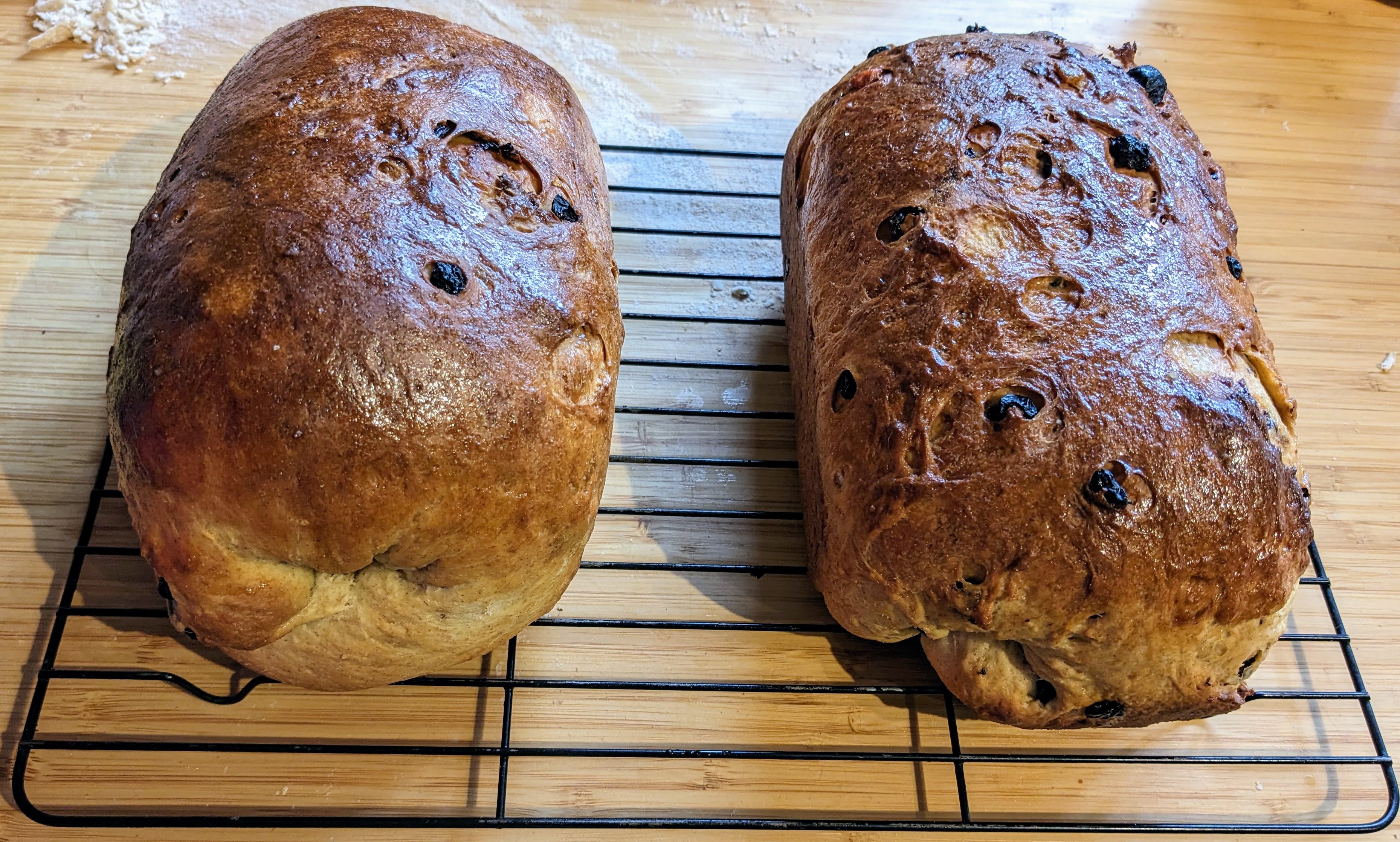
Apparently "barm brack" is Irish for "yeast bread". It's a rich, fruity bread full of butter, eggs, sugar, raisins, and candied fruit. It reminds me a bit of hot cross buns in loaf form.

I had a bit of trouble judging when these were done. I'm usually pretty good with that sort of thing, but I think the quantity of inclusions threw me off a bit. It was still tasty, the crust was just a bit thicker than it should've been because I didn't realize that I'd pulled it out of the oven too soon until after it had already cooled significantly. Other than that though, this recipe worked out very well. (And the Kidlet absolutely loved it!)


Barm Brack

Slightly adapted from Bernard Clayton's New Complete Book of Breads

Ingredients

  • 500g hard (strong/high grade/bread) or all-purpose flour
  • 1/2 c. sugar
  • 2 tsp. coarse sea salt
  • 1 tsp. lemon zest
  • 1 Tbsp. instant yeast
  • 1/2 c. unsalted butter
  • 3/4 c. water
  • 1/2 c. milk
  • 2 large eggs
  • 1 1/2 c. golden raisins
  • 1/2 c. mixed peel or mixed candied fruit
  • 1 tsp. sugar dissolved in 1 Tbsp. water

Directions

  1. Combine 180g flour with sugar, salt, lemon zest, and yeast.
  2. Combine butter, water, and milk and heat to ~50°C (~120°F).
  3. Add the hot butter mixture to the flour mixture and beat with a wooden spoon or the flat beater of a stand mixer for ~2 minutes.
  4. Add the eggs and another 100g of flour and beat for another 2 minutes.
  5. If using a stand mixer, switch to the dough hook at this point and continue adding flour ~1/4 c. (~30g) at a time until dough comes together into a shaggy mass.
  6. Turn out onto counter and knead by hand for 10-15 minutes (or continue working with dough hook in stand mixer for 2-4 minutes).
  7. Add a little more flour or water as needed during kneading in order to get a nice, smooth, relatively soft dough.
  8. Round the dough and place in a covered bowl to rise for 45-60 minutes.
  9. Knock back and turn out onto a lightly floured surface.
  10. Work in the raisins and the candied fruit.
  11. Divide dough into two equal portions and round each one.
  12. Cover and rest for 5-10 minutes.
  13. Meanwhile, grease two loaf 20x10cm (8x4") loaf pans.
  14. Flatten each round, letter fold, roll up, and place each loaf seam-side-down in one of the prepared loaf pans.
  15. Cover and allow to rise for another 45-60 minutes.
  16. Preheat oven to 190°C (375°F).
  17. Bake at 190°C (375°F) for ~40 minutes.
  18. Remove loaves from pans and return to oven without the pans for 10 minutes.
  19. Brush loaves with sugar glaze and return to oven for another 2 minutes.
  20. Turn oven off and allow loaves to sit in hot oven for another 5-10 minutes.
  21. Transfer to wire rack to cool.

Monday, 23 October 2023

Stroud's Cinnamon Rolls

These are not cinnamon rolls as I normally think of them. There's no icing. No spiral of cinnamon and sugar. They're shaped just like dinner rolls, but with a sweet, slightly salty, baked-on cinnamon glaze. And they are delicious!

Sadly, I don't think I remembered to snap a photo of these before they were all devoured. And it's been a while since I made them, so I can't remember a lot of the specifics about the baking process. I normally follow the recipe pretty closely for stuff like this though and I don't recall encountering any particular problems, so I assume everything went fine. I know the results were great and everyone really liked them!

Ideally I would have done the write-up for this recipe within a day or two of making the buns. But sometimes things just don't work out that way. And I figure I'd rather have a belated write-up than none at all!

Stroud's Cinnamon Rolls

From Cook's Country June/July 2020

Ingredients

Dough

  • 1/2 c. + 2 Tbsp. milk, warmed to ~45°C (115°F)
  • 1 large egg
  • 300g all-purpose flour
  • 1/2 Tbsp. instant (rapid-rise) yeast
  • 2 Tbsp. sugar
  • 1 tsp. coarse sea salt
  • 1/4 c. unsalted butter, softened

Coating

  • 250g (~1 1/4 c.) sugar
  • 4 tsp. ground cinnamon
  • 1/2 tsp. coarse sea salt, ground
  • 3/4 c. unsalted butter, melted

Directions

  1. Whisk egg into milk.
  2. Add flour and yeast and mix well1.
  3. Cover and let stand for 15 minutes.
  4. Add sugar and salt and knead for ~10 minutes (5 minutes with a dough hook on medium-low), gradually working in the butter as you go.
  5. Knead for another 10-15 minutes (or 5 more minutes with the dough hook).
  6. Shape into a smooth ball and place in a covered bowl to rise for ~1 hour.
  7. Meanwhile, combine the sugar, cinnamon and salt in a bowl.
  8. Transfer ~3/4 c. of the sugar mixture to a separate container and put the remaining sugar mixture in a shallow dish.
  9. Put half of the melted butter (6 Tbsp.) in another shallow dish.
  10. Grease a 9x13" (23x33cm) baking dish.
  11. Knock back the dough and divide into 15 equal portions (~37g each) and round each one into a tight, smooth ball.
  12. Roll the dough balls in the melted buter and then in the cinnamon sugar.
  13. Arrange the coated dough balls into 5 rows of 3 in the baking dish, cover, and let rise for ~1 hour. (It's okay if the coating "cracks" during rising.)
  14. Preheat oven to 180°C (350°F).
  15. Bake rolls until golden brown (~25 minutes).
  16. Whisk the reserved 3/4 c. sugar mixture into the remaining 6 Tbsp. of melted butter.
  17. Brush tops and sides of hot rolls with butter mixture. Use all of it!
  18. Leave rolls to cool in baking dish for 10 minutes.
  19. Remove from baking dish and serve warm.


1 I just mixed everything by hand because I didn't have a stand mixer at that point. However, the recipe suggests mixing on low for ~2 minutes with a dough hook if you have one. 1

Sunday, 27 November 2022

Parker House Rolls

I'm not sure why I was suddenly overcome with the desire to bake a batch of Parker House rolls, but... it happened.

This was my first time making them from scratch, although I do have some vague memories of making them with readymade Pillsbury dough as a kid.

They were easy enough to make. It's an enriched dough with a truly alarming amount of butter. The dough was very soft, but not at all sticky and it rose well producing light, buttery rolls. Sadly most of my rolls came unfolded, so I didn't end up with the characteristic Parker House shape. But they still tasted lovely regardless.


Parker House Rolls

Slightly adapted from Cook's Country October/November 2020

Ingredients

  • 550g all-purpose flour
  • 2 1/4 tsp. instant (rapid-rise) yeast
  • 1 tsp. coarse sea salt
  • 1 1/4 c. whole (3.25%) milk, tepid
  • 12 Tbsp. unsalted butter, melted, divided
  • 1 large egg
  • 2 Tbsp. sugar

Directions

  1. Combine flour, yeast, and salt and mix well.
  2. In a large measuring cup, combine milk, 8 Tbsp. of the melted butter, egg, and sugar and mix well.
  3. Make a well in the centre of the dry ingredients and pour in the wet ingredients.
  4. Gradually incorporate the flour, working from the centre outward.
  5. Cover and let rest for 10 minutes.
  6. Knead until smooth and elastic.
  7. Return to bowl, cover, and let rise at room temperature for 60-90 minutes.
  8. Knock back and divide into 24 equal portions: first divide into two equal portions, then shape each portion into a log, and divide each log into 12 equal portions.
  9. Cover dough pieces.
  10. Working with one at a time, carefully round each one: stretch and pinch dough to the bottom to form a smooth, taut gluen sheet on top; then roll on the work surface, creating a bit of pressure and friction to get it nice and round and smooth everything out.
  11. Set rounded dough lump aside, cover, and move on to next dough lump.
  12. Let rounded dough lumps rest for 10-15 minutes.
  13. Working with one ball at a time, press into a flat disc 6-7mm thick. Press the handle of a wooden spoon along the centre of the disc to form a trough/crease. Brush with melted butter. Then fold along the crease and press firmly. Transfer to a parchment-lined baking sheet and cover.
  14. Once all the rolls have been shaped, make sure they're covered and allow to proof for 45-60 minutes.
  15. Preheat oven to 180°C (350°F).
  16. Uncover rolls and brush tops with remaining melted butter.
  17. If you have a spray bottle, spritz them with a little water just before putting them in the oven.
  18. Bake at 180°C (350°F) for 20-25 minutes.
  19. Allow to cool on baking sheet for 10-15 minutes, then transfer to a wire rack to finish cooling.

Friday, 16 November 2018

Cinnamon Scrolls

I've been wanting to try out this cinnamon scroll recipe for ages. It's a fairly basic, yeasted, enriched dough cinnamon roll. But it's been a really long time since I've worked with an enriched dough and I was intrigued by the use of soft flour in this recipe. It seemed like a fun thing to try. And I liked the idea of keeping my first foray (back) into enriched dough fairy simple.

There are actually instructions for making sticky cinnamon scrolls (aka schnecken) after the main recipe. They sound amazing! But I wanted to stick to the basic recipe for my first go 'round. I'll definitely be trying the schnecken next time though. The basic cinnamon scrolls were nice, but slightly lacking in both sweetness and cinnamon flavour. Adding a sweet, sticky topping to them would certainly address the lack of sweetness. And I think I'd just double the cinnamon in the filling next time for an extra cinnamon-y kick.

Cinnamon Scrolls

Slightly adapted from Edmonds Cookery Book

Ingredients

Dough

  • 1 c. warm water
  • 4 tsp. active dry yeast
  • 1/2 c. sugar
  • 115g salted butter, melted
  • 3 eggs, lightly beaten
  • 1/4 tsp. salt1
  • 4 1/2 c. soft (plain/standard/cake) flour
  • 1/2 tsp. ground cardamom2 (optional)

Filling

  • 115g salted butter, softened
  • 1/2 c. brown sugar
  • 2 Tbsp. ground cinnamon3

Glaze4

  • 1 egg, beaten
  • 2 Tbsp. milk

Directions

  1. Dissolve 1 tsp. of sugar in the warm water and sprinkle with yeast. Set aside for 15 minutes.
  2. Stir in remaining sugar, melted butter, eggs, and salt and mix well.
  3. Add flour and cardamom (if using) and beat with a wooden spoon until smooth. The mixture will be fairly loose. Almost more like a thick batter than a dough.
  4. Cover and chill (in the fridge) for at least 2 hours or as long as overnight.
  5. After dough has chilled, turn out onto floured surface and divide in half.
  6. Roll each half out to a 30-35cm square.
  7. Spread half of the softened butter onto each square.
  8. Combine the brown sugar and cinnamon and mix well.
  9. Sprinkle half of the sugar mixture over each square.
  10. Firmly roll squares up and press edges to seal.
  11. Cut each log into 9 even pieces and arrange into two greased 8" (20cm) round tins.
  12. Cover with a cloth and leave to rise at room temperature for 1 hour.
  13. Combine beaten egg with milk and mix well.
  14. When rolls have risen, brush tops with egg mixture.
  15. Bake at 350°F (180°C) for 30 minutes.
  16. Let cool in tins for 5 minutes before turning out.
  17. Dust with icing sugar and serve warm.


1 The original recipe calls for 1/2 tsp. salt, but I halved it since there was already quite a bit of salt coming from the butter. Back
2 I didn't add any cardamom to mine. Back
3 The original recipe calls for 3 tsp. (1 Tbsp.) cinnamon. I didn't find that amount of cinnamon to have much impact though, so I'll definitely put a bit more in next time. Back
4 Full disclosure: I completely forgot to glaze my buns. They were still tasty, but I'm sure they would've had a much nicer finish with the glaze. Back